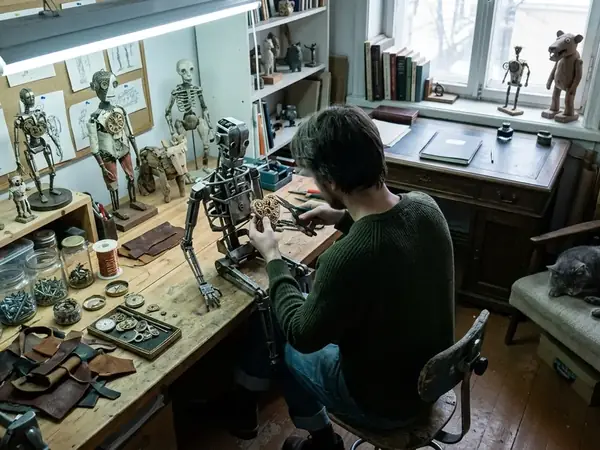
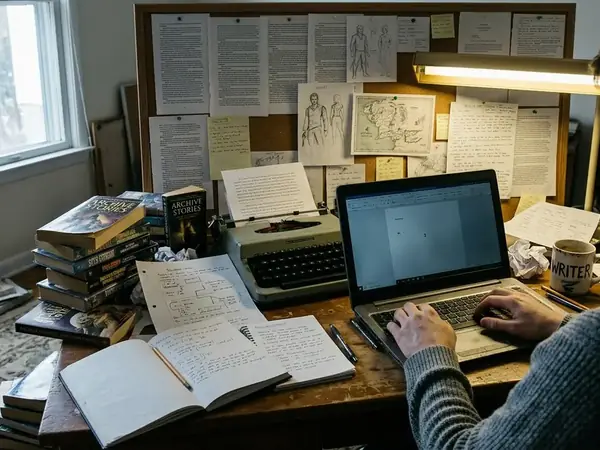
Key Takeaways: Artificial Personhood at a Glance
Building a structured editorial framework for an author's bibliography requires identifying the thematic currents that pull the work together. In the short fiction of A. Merc Rustad, one of the most vital currents is the continuous renegotiation of what it means to be a person.
- An Evolving Negotiation: The fiction treats personhood less as a fixed category than as an evolving negotiation among autonomy, embodiment, memory, relation, and recognition.
- A Speculative Continuum: Artificial intelligence and non-human protagonists exist as part of a broader speculative continuum rather than a single, isolated technology theme.
- Decade-Scale Context: This analysis follows the author's published short fiction over roughly the last decade, using publication context from the official bibliography to trace these themes.
Why Artificial Personhood Is the Right Lens
A common question when structuring literary metadata is how to categorize non-human protagonists without flattening their distinct narratives. I define artificial personhood for this article as the literary question of when a made, altered, engineered, digital, alien, or otherwise non-human being is treated as a subject rather than an object.
This phrase should not be limited to robots or software. In speculative fiction, personhood can appear through monsters, machines, ships, constructs, post-human bodies, animal-adjacent beings, or hybrid selves. Treating artificial personhood as synonymous with robot fiction would miss stories where personhood is tested through these alternative forms.
This lens connects directly to the author's genre position. When analyzing pieces published in venues like Fireside, the compressed forms of speculative short fiction often sharpen questions of agency and recognition. A single decision, a withheld name, or a sudden point-of-view shift carries the entire burden of establishing personhood within a limited word count.

A Decade-Scale Arc: From Recognition to Self-Definition
Organizing a bibliography chronologically often reveals developmental arcs that a purely alphabetical list obscures. Using publication order from the official bibliography during drafting, I track a distinct movement in emphasis across the author's work.
Earlier stories frequently ask whether non-human subjects can be recognized by the dominant systems around them. The narrative tension relies on external validation. Later work shifts the inquiry, asking how those subjects define themselves. The emphasis moves toward internal claims of selfhood, chosen relation, and the active refusal of imposed categories.
While this thematic chronology traces a distinct evolution across roughly the last decade of published short fiction, it is not a claim that every story participates equally in the artificial personhood motif. Instead, it highlights concentrated moments where a body modification, an act of refusal, or a reclaimed memory signals a shift in how personhood is constructed.
Autonomy, Consent, and the Problem of Use
Artificial or non-human persons are routinely placed under systems that want to use them. Institutions, creators, owners, militaries, archives, families, patrons, and social scripts all exert pressure on the protagonist to fulfill a designated function.
Autonomy in this fiction is not simply freedom from control—it is the capacity to choose relation, obligation, transformation, silence, or refusal. I ground my close readings of these texts in verbs of command and scenes of negotiation. We see protagonists redefining their assigned functions rather than merely escaping them.
In specific narratives such as The Collars We Wear, consent emerges as a recurring ethical test. The text asks who gets to ask for consent, who is allowed to decline, and whose desire is interpreted as a malfunction, threat, or inconvenience by the governing system.
Bodies That Refuse the Human Template
Readers often instinctively translate every non-human experience into familiar human psychology—a habit that obscures the text's actual mechanics. Non-human protagonists are not simply human minds placed in decorative speculative bodies.
Altered, digital, animal, mechanical, alien, monstrous, or constructed bodies fundamentally change perception, desire, vulnerability, language, and social legibility. To progress beyond a surface-level reading, one must pay attention to what remains strange, partial, or untranslatable in the protagonist's physical experience.
I recommend tracking sensory verbs, scale, hunger, interface mechanics, damage, and repair. Distinguishing between embodiment as a literal speculative condition and embodiment as a metaphorical resonance allows the reader to appreciate the specific architectural choices of the fiction.

Voice, Memory, and the Right to a Name
Narration itself functions as a site of personhood. First person, second person, fragmented narration, collective voice, and withheld names all shape how subjectivity appears on the page. A sentence's grammar can reveal agency, coercion, self-recognition, or constrained choice.
Naming acts as a recurring threshold between object and person. A given name, a chosen name, a refused name, a serial designation, a species label, or a title indicates exactly who controls identity in the narrative ecosystem.
Similarly, memory operates as a contested archive. For artificial or constructed beings, memory is rarely a natural given. It may be programmed, partial, communal, stolen, edited, embodied, or deliberately reclaimed. The act of remembering becomes an act of defining the self against the system that originally formatted the mind.
Queer and Nonbinary Resonance Without Flattening the Fiction
Artificial personhood frequently resonates with queer and nonbinary questions. Being misread by institutions, resisting assigned categories, negotiating embodiment, claiming names, and building kinship outside sanctioned forms are all central to both the speculative narratives and queer experience.
However, turning every non-human protagonist into a direct allegory for gender would flatten the fiction and erase craft elements such as voice, body, memory, and narrative withholding. I present this resonance as one interpretive layer among craft, genre history, ethics, and narrative structure.
By keeping the argument literary rather than biographical, we honor the complexity of the text. The official author site provides a public contextual frame, but the analytical claims must remain tied to the specific literary situations occurring within the stories.
How to Read the Bibliography Through This Theme
Approaching a decade of short fiction requires a practical reading map. Readers can move through the bibliography by protagonist type, by publication chronology, or by the specific ethical questions raised in the text.
Expert Tip: Readers studying the theme should track five recurring signals in each story: who speaks, who names, who commands, who remembers, and who is believed.
This framework yields three distinct audience pathways through the bibliography. Reviewers can follow the craft and genre conversation. Educators can pair stories by their central ethical question. Convention organizers can identify specific discussion angles around AI, autonomy, and queer SFF. To put the map to work, start with The Collars We Wear and apply those five signals in order—watch how the question of consent shifts the moment you ask who is actually permitted to decline. Trace that one boundary and the moving line of personhood across the whole bibliography comes into focus.