In this Article
- How one SFF story can gather several publication records without becoming several original works
- Where format labels end and publication-status labels begin
- What rights language can and cannot tell a reader from the outside
- How to record online, audio, anthology, and archive appearances without overcounting
Key Takeaways: How SFF Stories Move Between Venues
Main Point: An SFF story may appear first in a magazine, later as a reprint, then as an audio podcast episode or anthology inclusion. Those later appearances can be real, citable publication records. They do not automatically reset the story’s original publication date.
The confusion usually starts with a good instinct. A reader sees the same title in several places and tries to honor each appearance. That instinct serves literary history well. It only needs a steadier vocabulary.
I keep five terms close when reading short-fiction records.
- First publication means the earliest public appearance of the story in a venue that published it as new work.
- Reprint means a later publication of a story that has already appeared elsewhere.
- Podcast publication means an audio release, which may be original audio, an audio reprint, or an audio version tied to a text publication.
- Online publication means the story appeared in web-based form, often in an online magazine issue or publisher page.
- Archive availability means the story remains findable later, perhaps on a venue archive, an author archive, or a preserved publisher page.
Those terms answer different questions. Date, format, venue, and rights language are the four filters I use before treating any line in a bibliography as evidence. A live page is useful, but it is not the whole record.
A story title appearing three times in an author bibliography may indicate circulation history, not three separate original stories.
A Practical Map of the Main SFF Publication Paths
One Story, Several Legitimate Entries
Take a hypothetical story called “The Glass Orchard.” It sells first to an online SFF magazine and appears in that venue’s issue month. A season later, an anthology editor selects it as a reprint. After that, a podcast releases an audio adaptation on its own episode date. The author then updates a bibliography so readers can find the text, anthology, and audio records in one place.
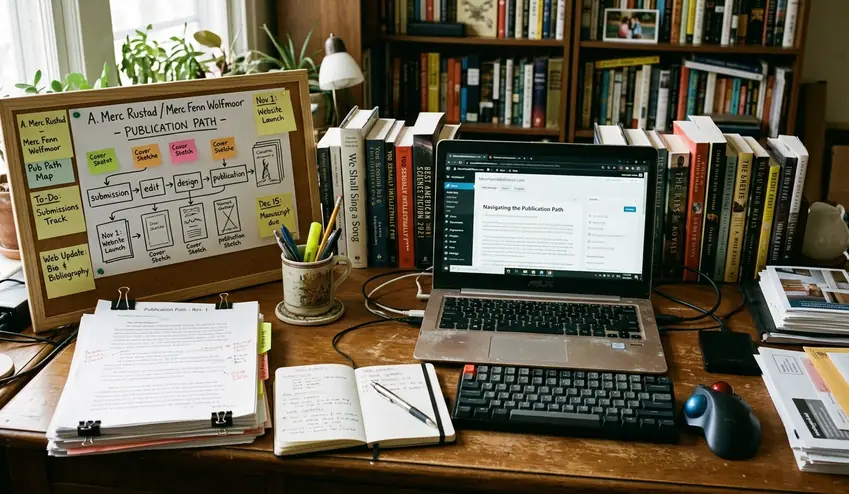
Nothing in that chain is suspicious. The record has accumulated.
The trap is treating format as status. Online text, print anthology, ebook anthology, and audio podcast are formats. Original and reprint describe the story’s publication history. A print anthology can contain original work or reprints. An audio podcast can premiere a story in sound or adapt a piece that first appeared in text.
Start with the Earliest Dated Venue
When I teach this to newer bibliography helpers, I ask them to begin with the earliest dated venue rather than the most visible current link. Search engines often reward what is still online, not what came first. An author page for Merc Rustad, author, may be clearer than a broken magazine page. A publisher archive may be older than a later classroom handout. A venue like Fireside as a publication venue may have its own issue structure that matters for citation.
Expert Tip: First find the earliest dated appearance. Then decide whether later entries are reprints, audio versions, archive copies, or anthology placements.
This is where a tidy map saves grief. The question is not “Where did I find it?” The better question is “Where did the story enter the public record first?”
Rights, First Publication, and Why Terms Matter
Rights Are Permissions, Not a Biography of the Whole Work
Publishing rights are specific permissions attached to specific uses. They are not ownership of the writer’s entire imagination unless a contract says something extraordinary, and public bibliography pages rarely show enough to decide that. The baseline distinction between copyright ownership and licensed uses is explained by the U.S. Copyright Office explanation of copyright basics, but the actual contract controls the permitted use.
In short-fiction records, several rights labels appear often enough that readers should know their practical shape.
- First serial rights usually point to the right to publish the story first in a periodical or serial venue.
- Nonexclusive reprint rights usually allow a later venue to publish a previously published story without being the only venue that may do so.
- Audio rights cover a spoken or produced sound version.
- Electronic rights cover digital distribution, though the scope depends on contract language.
- Archival rights address whether a venue may keep the work available after the initial release window.
Eligibility questions sit beside rights questions, but they are not identical. An award administrator, anthology editor, teacher, or reviewer may ask: Was the story previously published? Was this version substantially revised? Did this appearance happen as text, audio, or anthology publication?
That is why short labels matter. “Reprint” is not an insult. “Archive” is not a demotion. “First appeared” carries chronological weight.
Podcast Publication: Audio Adaptation, Reprint, or Both?
The Common Question
Does a podcast count as publication?
Yes, but the next sentence matters more. A podcast appearance may be an original audio publication, an audio reprint of a previously published text, or a commissioned audio version tied to a magazine release. Treat it as a format-plus-status question, not a single category.
What the Audio Record Adds
A podcast episode can add a narrator, performance choices, production, host commentary, intro notes, outro notes, and episode metadata. Those details matter. They help a listener understand reception, framing, accessibility, and venue identity.
They do not, by themselves, change the original text publication date.
A grounded pattern looks like this: first appeared in an online magazine, later adapted for an audio episode. The audio episode has its own release date. It may also be the first audio publication. At the same time, the prose remains previously published because the text appeared earlier elsewhere.
Caution: A podcast episode may be a first audio publication while the same story remains a text reprint because the prose appeared earlier elsewhere.
For bibliography work, record the episode title, story title, narrator when relevant, podcast name, release date, and prior text appearance if known. If the podcast title differs from the story title, keep both. Future readers will thank you when they search one phrase and land on the other.
Online Publication, Archives, and the Long Life of a Story
Availability Is Not Origin
Online SFF has a long afterlife. A story can remain on a magazine site years after its issue month. It can move into a publisher archive. It can disappear from a venue and survive only in a citation, an author bibliography, or a web archive. The historical fact of publication and the current state of availability are related, but they are not the same thing.
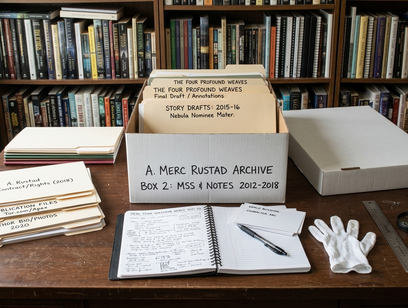
That distinction becomes practical when a reviewer returns to a note months later and finds a redirected page. It becomes urgent when an educator prepares a syllabus and the story has moved. It becomes maddening when a bibliography maintainer sees a page title change, an issue number vanish, or an author bio update in a way that obscures the older record.
A live URL is not proof of original publication; it may be an archive copy, a later repost, or a publisher page preserved after the issue window.
What to Capture Before the Link Breaks
Record stable details before leaning on a URL. Venue name. Publication date. Issue number when available. Format. Current availability state.
Metadata drift is not dramatic, but it is persistent. Page titles change. Issue numbers go missing. Author bios expand. Archive pages redirect. The story has not changed, yet the trail around it has.
For a work such as The Collars We Wear, or for any A. Merc Rustad author listing, the same care applies: cite what the record actually says, then separate that evidence from what you infer.
How to Read a Bibliography Entry Without Overcounting
The Entry Is a Stack, Not a Scorecard
A clean bibliography entry should help a reader answer six questions: What is the story title? Where did it appear? Who edited or published it when that matters? When did it appear? What format was used? Was the appearance original or a reprint?
Here is the model I prefer for a story with several appearances:
Story Title — original publication: venue, date, format; reprint: anthology or magazine, date, format; audio: podcast, episode date, narrator if relevant.
That structure keeps the original publication visible while still honoring later circulation. It also prevents a familiar mistake: counting every line as a new work by the author.
Use the Version You Actually Consulted
For teaching, reviewing, or convention programming, cite the version actually used. If you listened to the podcast, cite the podcast details. If you read the anthology, cite the anthology. When discussing publication history, acknowledge the earlier appearance.
This is not fussy bookkeeping. It is reader service.
There is also an ethical dimension. Editors, narrators, publishers, and archive maintainers all shape access. A good record gives them their proper place without stealing the chronology from the story’s first venue.
Scope and Limitations: What This Guide Can and Cannot Verify
Where the Map Holds
This guide explains common short speculative fiction paths: magazines, online issues, reprints, podcasts, anthologies, archives, and author bibliography entries. It is built for readers, reviewers, educators, organizers, and bibliography researchers who need to interpret public records with care.
It does not cover novels, self-publishing platform mechanics, film rights, television rights, or unpublished submission history. Those systems have their own vocabulary and pressure points.
Where the Public Record Thins Out
Contractual status for a specific story cannot be determined from a public bibliography alone; the relevant agreement controls licensed uses. Public records are often thinner than the rights history behind them.
Markets also use terms differently, especially around simultaneous online and audio releases, anthology exclusivity windows, revised versions, and archival permissions. If exact eligibility, award timing, or editorial provenance matters, official author-site bibliography context is useful, but check it against venue records when those records are available.
Caution: Do not treat a neat bibliography line as a substitute for contract language, eligibility rules, or venue documentation.
Checklist: Tracing a Story’s Publication Path
A Repeatable Method
When a story has moved through several venues, slow down and make the record answer in order. The method is plain because the work often happens under deadline: a review due tomorrow, a class list closing, a convention panel description needing one accurate sentence.
- Identify the earliest dated appearance. Find the first venue date before assigning original-publication status.
- Separate format from status. Text, print, ebook, audio, and archive are formats. Original and reprint are history labels.
- Record the venue. Include the magazine, anthology, podcast, publisher, or archive source.
- Record the date. Use the issue month, anthology date, or podcast episode date as appropriate.
- Add editor or publisher when available. This is especially helpful for anthologies and magazine issues.
- Note current availability. Is the story live, archived, behind access limits, redirected, or no longer findable at the old link?
The result should be modest and durable: one story, one earliest publication record, and as many later appearances as the evidence supports. That is usually enough to keep the literary trail clear without flattening the story’s travels.