Your Speculative Fiction Syllabus at a Glance
Begin with capacity. Two stories per week across 12 weeks creates 24 possible reading slots. Treat that figure as a ceiling rather than an assignment: catch-up and synthesis weeks need room, especially once a difficult story asks for a second reading.
A useful syllabus starts with a governing question, then moves through discovery, selection, sequencing, annotation, and review. That order matters. Starting from a pile of admired titles usually produces a reading list shaped by memory and recommendation feeds rather than inquiry.
The Working Route
- Choose one reading question.
- Map several discovery sources.
- Balance familiar anchors with frontier selections and wildcards.
- Schedule stories as deliberate pairings.
- Use the same annotation method each week.
- Review patterns and absences at midpoint and completion.
I divide the candidate pool into three lanes. Anchors come from familiar writers, publications, or forms and establish context. Frontier stories arrive through unfamiliar venues or writers and enlarge the map. Wildcards sit outside the reader’s usual preferences and protect the syllabus from becoming too obedient to its own design.
This structure creates a flexible personal curriculum, not a definitive survey of contemporary speculative fiction. Its value lies in making the reader’s choices visible enough to examine.
Step 1: Give the Syllabus a Reading Question
The most common early question is simple: how specific should the syllabus become?
Specific enough that each candidate has to earn its place. Write the final question before collecting stories, then test every title by completing one sentence: “This story may help answer the syllabus question because…” If the answer stops at “it is science fiction” or “people liked it,” the connection needs more work.
Choose the Kind of Inquiry
- Theme-led: How does climate fiction handle agency?
- Craft-led: How does recent fantasy use second-person narration?
- Market-led: How do different publication venues frame stories that cross horror and science fiction?
- Historical comparison: How has short fiction’s treatment of chosen family changed across selected periods?
A theme-led syllabus often begins with subject matter and moves toward technique. A craft-led version reverses that emphasis, asking how voice, structure, pacing, or endings shape meaning. Market-led reading attends to editorial context and publication routes. Historical comparison requires especially careful boundaries because a handful of available stories can make a period appear more uniform than it was.
Set three limits in advance: a 12-week window, a weekly capacity of two stories, and one intended final output. The output might be a reflective essay, a set of paired notes, or a revised reading map. Giving the work a destination helps prevent annotation from expanding without purpose.
Step 2: Build a Source Map Beyond Your Usual Feed
Discovery works best in passes. Start with current SFF magazine contents pages and publisher newsletters, which support timely browsing. Then add anthology contents, author bibliographies, review venues, interviews, and award lists. Each route reveals a different slice of the field.
Award lists and anthologies record reception and retrospective visibility. They remain partial signals rather than complete measures of quality or publication activity. A syllabus drawn from many titles can still be narrow when those titles pass through the same editors, review circles, or recommendation feeds.
Record the Discovery Route
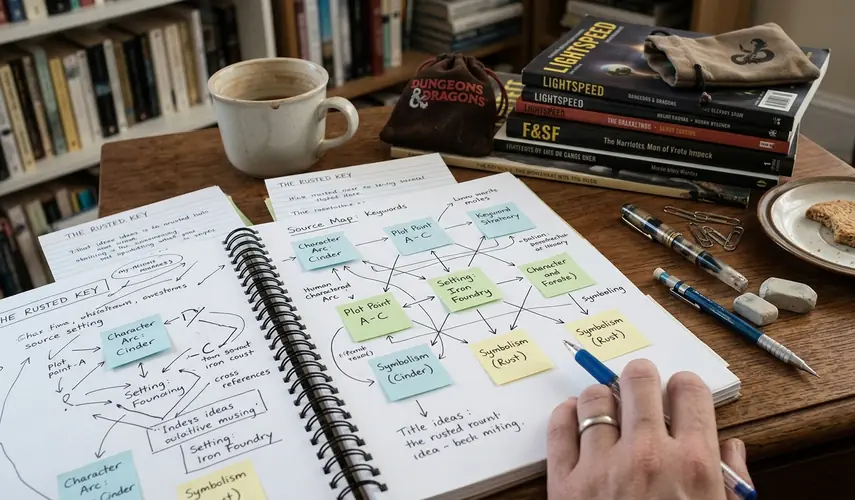
A simple spreadsheet or notebook is enough. Give each candidate a row and record:
- publication name;
- issue or publication date;
- access method;
- story title and author;
- the route through which you found it;
- status: unread candidate, confirmed selection, completed reading, or revisit later.
The discovery-route field is especially revealing. If most candidates came from one review venue, one social feed, or one familiar table of contents, the source map has already found a gap.
Verify the Listing
Check publication status, issue details, and access conditions on the venue’s official page when adding a story and again before its scheduled week. Links move, access changes, and bibliographic mistakes become harder to untangle once notes accumulate.
For example, a candidate record involving Merc Rustad: author might list the specific story title, its venue, the date shown by that venue, and whether discovery came through an author bibliography or a magazine archive. If a title such as The Collars We Wear enters the pool, its relevance still needs to pass the syllabus question. Recognition alone does not settle selection.
Step 3: Select Stories with a Transparent Balance
Selection becomes easier when every candidate faces the same compact matrix. The aim is comparison across several dimensions at once, with brief notes rather than elaborate scoring.
Compact Story-Selection Matrix
- Relevance: What part of the reading question could this story illuminate? Require a specific connection.
- Unfamiliarity: Does the writer, venue, editorial context, or approach extend the existing reading map?
- Form or subgenre: Which narrative form, speculative mode, or genre boundary does the story bring?
- Publication context: Does the list rely repeatedly on the same editorial ecosystem?
- Access: Can the story be read through a stable, legitimate route during its scheduled week?
- Manageable length: Can the story fit beside its partner without turning the week into recovery work?
Anchors establish a baseline. A familiar author such as A. Merc Rustad: author, or a known venue such as Fireside: publication venue, may give the reader a stable point of comparison. Frontier selections widen the source map. Wildcards introduce an element that the matrix cannot fully predict.
Before confirming the list, check for repeated editorial ecosystems, near-duplicate premises, absent narrative forms, and choices retained solely because they already carry institutional recognition. Compare stories across multiple dimensions instead of compressing diversity into a single checkbox. Geography or personal perspective belongs in the record only when the writer has made that information public through a reliable biography or interview.
A clean-looking balance can still hide sameness. Five publications may lead back to overlapping editorial circles; five distinct premises may use nearly identical structures. Read the matrix across the row and down the column.
Step 4: Sequence the Reading for Contrast and Momentum
Once the pool is stable, stop thinking in discovery order. Build weekly pairings with an explicit comparative reason.
One week might place an optimistic future beside a bleak one. Another could pair an intimate domestic scale with a panoramic social canvas. Traditional and experimental structures often make productive companions, as do two stories that begin from the same speculative premise and pursue sharply different consequences.
A Sustainable 12-Week Architecture
- Week 1: orientation, question refinement, and source-map review.
- Weeks 2–9: four two-week comparative clusters.
- Week 10: two wildcard readings chosen after the clusters are underway.
- Week 11: catch-up, rereading, and unfinished notes.
- Week 12: final synthesis.
This plan assigns 20 new stories and leaves four of the theoretical 24 slots open for schedule changes, unfinished reading, and review. That breathing room often determines whether the final weeks produce analysis or merely completion.
Alternate demanding work with more accessible reading. Difficulty can arise from density, unfamiliar form, emotional intensity, or the need for contextual research. Two short stories may still make a punishing pair when both require slow reconstruction.
Pairing also has limits. A connection that sounds productive from summaries may collapse after reading because the stories use their shared premise for unrelated formal purposes. Revise the sequence when that happens; preserve the stories, but find each one a more illuminating companion.
Step 5: Read with a Repeatable Annotation Method
Readers often begin with underlining and end with a page full of luminous fragments. A repeatable note makes those fragments usable.
The Seven-Part Story Note

- Citation details.
- A one-sentence premise.
- Formal choices.
- The central tension.
- One striking image.
- The story’s relation to the syllabus question.
- One unresolved question.
During the reading, capture brief observations. After finishing, write a short synthesis within about ten minutes whenever possible, while the structure and ending remain easy to retrieve. The synthesis can be compact: one paragraph describing what the story does, followed by one paragraph evaluating how that work affects the governing question.
Separate the Layers
Write description before evaluation. Record point of view, structure, pacing, worldbuilding, speculative device, language, and ending strategy before deciding whether those choices succeeded for you. Immediate reaction matters, but it should not replace close reading.
This separation becomes valuable during comparison. “The ending felt abrupt” records a response. “The ending withholds causal resolution after shifting from scene to summary” identifies a formal choice that another story can be measured against.
For public-facing notes, quote only the passage needed to support the claim and check the publication’s current guidance before reproducing substantial text. Most comparative observations become sharper when the quotation remains small and the analysis carries the weight.
Step 6: Review the Pattern, Including What Is Missing
Review the syllabus twice. Conduct a midpoint audit after week 6 and a final audit during week 12.
The midpoint review should challenge the shape taking form. Which themes keep returning? Which narrative techniques dominate? Are the emotional registers clustering around dread, wonder, grief, or consolation? Have familiar publication routes quietly crowded out frontier sources?
Questions for the Midpoint Audit
- Which sources have been repeatedly overlooked?
- Which forms or genre crossings have been avoided?
- Which publication contexts are missing?
- Have wildcard slots been replaced by familiar authors?
- Does the current sequence still serve the reading question?
The final review moves from correction to synthesis. Compare recurring themes, techniques, emotional registers, publication routes, and assumptions about genre boundaries. Then distinguish conclusions supported by these selections from claims that would require a broader reading base.
This is where a personal syllabus earns its critical value. The notes reveal how the sample was made, what it favored, and where silence entered. A thoughtful conclusion can remain firm while naming the edge of its evidence.
Keep One Slot That Can Still Surprise You
Deliberate selection gives a syllabus coherence. Discovery gives it life.
Keep the first cycle small enough to finish, and preserve every story note for later comparison. The second syllabus will then begin with a record of earlier preferences rather than a vague memory of them. Over time, repeated source maps and annotations show which venues, forms, and tonal registers receive attention almost automatically.
In the sample architecture, week 10 holds two wildcard readings selected only after the first four comparative clusters are underway. Choose them from a discovery route that has produced little else, an unfamiliar publication context, or a form you would usually postpone. Do not force the wildcard to confirm the question. Let it test whether the question remains adequate.
Protect the wildcard slot; it is the part of the syllabus I would never cut.