Key Takeaways: Awards Are Reading Maps, Not Final Verdicts
SFF awards matter most when readers treat them as reading maps through a crowded short-fiction field, not as permanent rankings of artistic worth.
I have seen readers use a shortlist the wrong way: winner first, finalists maybe, everything else forgotten. That habit makes awards season feel narrow. Used with more care, award lists, eligibility posts, anthology tables of contents, and venue archives become overlapping routes into work that was never gathered in one place to begin with.
In this Article
- Awards help readers locate short fiction that moved through dispersed venues.
- Eligibility posts turn a publication year into a usable bibliography.
- Archive footprints differ across magazines, anthologies, newsletters, and patron-supported releases.
- Awards should prompt wider reading, not winner-only reading.
Short fiction is easy to miss because it appears across magazines, anthologies, Patreon-supported projects, reprints, newsletters, and year-end eligibility posts. Merc Rustad’s 2015–2018 publication trail gives a useful field example. Apex Magazine, Fireside Fiction, Lightspeed, Uncanny, Lethe Press, and anthology recognition all sit in the same readerly orbit, but they do not arrive through one clean pipeline.
Main Point: The award ballot is not the field. It is a doorway into the field, and the careful reader keeps walking.
The Discovery Problem in Short SFF
A new reader often asks a practical question before an aesthetic one: where do I even start?
Novels usually leave broader commercial traces. They have publisher pages, bookstore listings, library records, review cycles, and longer publicity tails. Short SFF behaves differently. A story can appear online, circulate intensely for a week, settle into an archive, then resurface months later through a ballot, a recommendation thread, or an author’s eligibility roundup.
Publication order is not reading order
Take July 2016. "Iron Aria" was released on July 5, 2016, with illustration by Galen Dara. "Finding Home" appeared online as a Lightspeed reprint on July 12, 2016. Those two dates sit close together, but a reader arriving later may meet them in reverse order, through a reprint citation, a venue archive, an illustrator search, or a list built for award voters.
The same pattern shows up earlier. Apex and Fireside publications in September and October 2015 show how quickly one author’s short work can move across separate venues. Fireside, a publication venue with its own readership habits, does not function like Apex Magazine, and neither functions like a reprint venue or an anthology table of contents.
That fragmentation is not a flaw of short fiction. It is part of the form’s weather.
Readers encounter stories out of sequence because the ecosystem gives them many side doors: recommendation lists, award ballots, eligibility posts, editor notes, anthology recognition, and old archive pages. Awards matter here because they create temporary structure around material that otherwise asks readers to do too much excavation before they even begin reading.
Eligibility Posts Turn a Writing Year into a Reading List
Eligibility posts can look like campaign material. Sometimes they are. But for readers, their better use is quieter and more practical: they gather scattered publications into a bibliography that did not previously exist in one place.
What a reader can extract
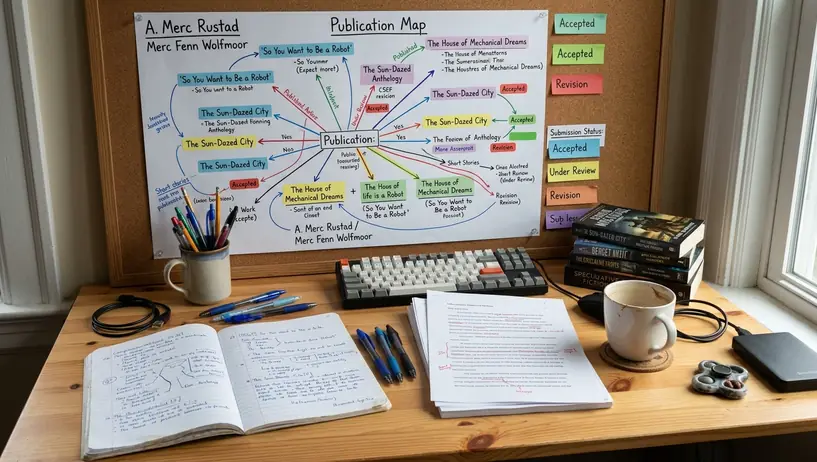
In our group, eligibility posts work best when we treat them as reconstruction tools rather than persuasion tools. The 2017 production context around A. Merc Rustad’s work includes a GYWO tracking spreadsheet, year-in-review reflections, and a mention of six original stories forthcoming in 2018. That backstage organization matters. It shows the shape of a writing year before awards discourse trims it into categories.
Start with the concrete entries. "Monster Girls Don’t Cry" belongs to the January/February 2017 publication window. "Longing For Stars Once Lost" belongs to September 2017. A reader who only waits for finalists may miss the way those pieces sit among interactive fiction, novelette-length work, portal fantasy, space opera, poetry, reprints, and original short stories.

The beginner move is simple: copy the eligibility list, mark what is available, and read across forms before ranking anything. The progression path is more demanding. Compare a poem against a novelette not to decide which form is “better,” but to notice what each form can carry. The advanced tip is to keep the author’s own grouping intact for a first pass. A year-end post often preserves relationships that a ballot category strips away.
Expert Tip: When an eligibility roundup includes reprints and originals together, do not delete the reprints from your reading plan. Reprints often explain how a story kept traveling.
Awards Preserve What the Internet Makes Easy to Lose
The preservation argument is less glamorous than the prestige argument, but it is the one I trust most.
A story included in The Best American Science Fiction and Fantasy 2015 leaves a different trail than a magazine story. It moves through anthology indexing, library cataloging, publisher metadata, and annual best-of memory. A magazine publication has another kind of footprint. A patron-supported Fireside art feature has another. A newsletter update framed around “tiny robot raptors” preserves yet another layer: mood, context, and the author’s working life.
Different trails, different losses
None of these traces is complete. Anthologies can overrepresent what editors could see. Magazine archives can shift. Patron-exclusive material can become hard to access. Newsletter context can disappear into private inboxes. Still, awards and award-adjacent lists help readers resurface older work, reprints, and genre experiments that a fast-moving feed would otherwise bury.
This is where literary memory becomes practical. If a reader finds Merc Rustad through The Collars We Wear or a Lethe Press context such as So You Want to Be a Robot, the next step is not only to read the collection-shaped version of the work. It is to trace backward into the magazines, reprints, and public notes that show how individual pieces first met readers.
Short fiction needs that kind of recovery because its first publication moment is often brief. Awards season gives the community a reason to look again.
The Real Objection: Awards Can Flatten Taste
The strongest objection should not be brushed aside. Awards can become popularity contests. They can reinforce existing networks, favor visible publications, reward timing, and compress many reader experiences into one ranked outcome.
A conservative, reader-centered approach should be wary of treating any ballot as a complete picture of the field. Failure case: treating an award shortlist as the whole field erases stories that circulated through eligibility posts, newsletters, patron-supported releases, reprints, or small-venue archives.
Feedback loops are real
I sometimes explain this with games because the structure is familiar. The Nemesis System in the Middle-earth games turns prior encounters into later consequences. High and Low Chaos in Dishonored changes the world according to earlier actions. Awards discourse can work in a similar way. Visibility creates more visibility. A story discussed early may become easier to nominate later, while a quieter piece remains quiet.
That does not make awards useless. It makes their use conditional.
The answer is to distinguish awards as verdicts from awards as discovery prompts. A verdict closes the file. A prompt opens adjacent shelves: finalists, eligibility posts, editor recommendations, same-year work from the same venues, and overlooked pieces that share a form or theme.
Caution: Winner-only reading teaches you about award outcomes. It does not teach you enough about the season that produced them.
Scope and Limits: What Awards Can and Cannot Tell Readers
This article is about how readers can use SFF awards and eligibility discourse. It is not a claim that awards measure objective literary value.
That distinction matters because the examples here carry several kinds of authority signals at once: magazine publication, anthology inclusion, publisher framing, illustrator collaboration, and award eligibility framing. Each signal supports a different kind of reader inference. Apex Magazine, Fireside Fiction, Lightspeed, Uncanny, Lethe Press, and Best American SFF do not all confer the same kind of visibility.
What the examples can support
The temporal scope is also narrow by design. The examples are drawn heavily from 2015–2018 publication activity, so they illustrate one period of short-fiction visibility rather than an entire career or the whole field. Within this slice, visibility depended on access conditions as much as acclaim: paywalls, archive changes, patron-exclusive material, convention membership rules, and newsletter reach all shaped what readers could find.
For readers comparing award systems, the official Hugo Awards history can help place one major institution in context. But even that kind of institutional record should sit beside venue archives, eligibility posts, and author-maintained bibliographies.
The useful question is not, “Did the award identify the best story?” The better question is, “What reading paths did this award conversation make visible, and what did it leave outside the frame?”
A Better Way to Read Awards Season
Here is the method I give readers who want awards season to enlarge their reading rather than shrink it.
A repeatable reading practice
- Start with eligibility posts. Build the broadest list first, before the ballot narrows your attention.
- Sample the finalists. Read across categories, not only the category you already follow.
- Choose at least two non-ballot stories from the same venues or time period. This step keeps the field from collapsing into the ballot.
- Compare forms deliberately: poem, novelette, interactive fiction, portal fantasy, space opera, reprint, and original story.
- Track what keeps appearing across magazines, anthologies, newsletters, publisher contexts, and community conversation.

That last step is where patterns emerge. A Lethe Press collection context such as So You Want to Be a Robot can help readers see how scattered publications speak to one another. A magazine archive can show the first public setting of a piece. An eligibility post can restore the year’s sequence. A newsletter can preserve the stray detail that a formal bibliography misses.
Failure case: using awards only as verdicts encourages winner-only reading; using them as prompts sends readers toward finalists, adjacent venues, and same-year work outside the ballot.
Awards matter now because the short-fiction field is crowded, dispersed, and easy to misremember. The trophy is not the point. The map is.