Key Takeaways for Strong SFF Writer Interviews
Interviewing a speculative fiction writer is an act of archival creation. The questions you ask today become the context future readers use to understand the work. Because moderators, reviewers, educators, and editors often prepare under tight deadlines, establishing a clear framework early prevents the conversation from defaulting to generic plot summaries.
Main Point: A weak interview asks only what the book or story is about; a stronger SFF interview asks how the impossible element changes structure, voice, embodiment, consequence, or reader expectation.
To build that stronger interview, focus on six specific angles: craft process, speculative premises, identity, publication context, reader impact, and boundaries. The first practical recommendation for any host preparing shortly before a recording is to secure the author's boundaries before drafting the main explanatory sections. Identity-related questions must always be invitational, never extractive, particularly when discussing queer, trans, nonbinary, disabled, or marginalized experiences.
Why Topic Choice Matters in Speculative Fiction Interviews
A common question from new interviewers is how to balance the needs of the audience with the depth of the author's work. SFF interviews carry multiple jobs at once. They introduce new readers to a world, document craft choices, preserve genre conversation, and give reviewers or educators usable context.
We must distinguish between promotional usefulness and literary usefulness. Promotional questions ask what a story is about. Literary questions ask how it works and what pressures shaped it. The decision path moves from the interviewer’s immediate need to the text's long-term archival value.
A thorough preparation pass should check the official biography, the current bibliography page, and any author-approved appearance listings before questions are finalized. Following this, a close-reading pass should identify at least one scene, image, structural choice, or line-level feature that can anchor a question. This grounds the conversation in the text rather than abstract assumptions.
Craft and Process Questions That Reach Beyond Routine

Many beginner interviewers ask where ideas come from. As you progress, you learn to ask how ideas are executed. The craft section of an interview should explore the exact point where a speculative premise becomes an actual piece of writing.
Interviewers should read at least one complete story, poem, essay, or book excerpt relevant to the interview before asking process questions. For example, reading a complex piece like The Collars We Wear provides specific grounding for questions about pacing and emotional resonance. Instead of asking only where ideas come from, we move through drafting, revision, and structure—the point where the impossible takes on weight.
Expert Tip: For a short interview slot, prepare three craft questions: one about origin, one about revision, and one about the speculative mechanism or formal choice.
Useful process prompts include:
- "Which image or emotional problem arrived first?"
- "What did the story resist during revision?"
- "Where did the final version differ most from the first draft?"
In SFF, process angles also involve building rules for magic or technology, deciding what to leave unexplained, using sensory detail to make impossible events feel embodied, and balancing wonder with consequence.
Identity, Naming, and Consent in Author Questions
Early in my career, I witnessed panels where marginalized authors were asked to serve as encyclopedias for their demographics. Identity questions become extractive when they ask the writer to explain an entire community, define terminology on demand, or turn personal history into a credential for the work. This flattens both the author and the text.
Identity should be treated as a possible context for interpretation rather than a compulsory explanation the author must provide. The phrasing guidance here gives the writer control over whether identity is discussed at all.
Use consent-forward stems such as:
- "If you’re comfortable discussing it..."
- "How, if at all, does this context affect how you think about the story’s reception?"
Caution: Public biographical details should be checked against current author-approved materials within roughly a month before publication or recording when the interview will reference names, pronouns, or identity language. This is especially critical for trans and nonbinary authors whose public-facing language may evolve.
Genre Lineage, Influence, and Conversation
Speculative fiction is not a single inherited canon. It is a web of conversation, adjacency, argument, refusal, and community circulation. Framing influence this way allows the writer to position their work actively.
When developing questions, build topic clusters. These clusters should include fairy-tale retellings, space opera inheritance, horror-inflected SFF, mythic structures, animal transformation, posthuman bodies, climate futures, and the politics of worldbuilding. By offering these specific clusters, you invite the author to discuss their work's lineage with precision.
Comparative prompts should be precise but non-leading. Ask, "What genre expectation did you want to satisfy, complicate, or refuse?" or "Which tradition were you writing beside rather than inside?"
In our group, we found that publication venue, anthology theme, and magazine context can be used as supporting evidence when they are tied to a specific story or reprint history. Discussing a piece's placement in Fireside: publication venue known for specific editorial stances, adds a layer of critical context to the interview.
Questions for Bibliographies, Awards, and Public Appearances
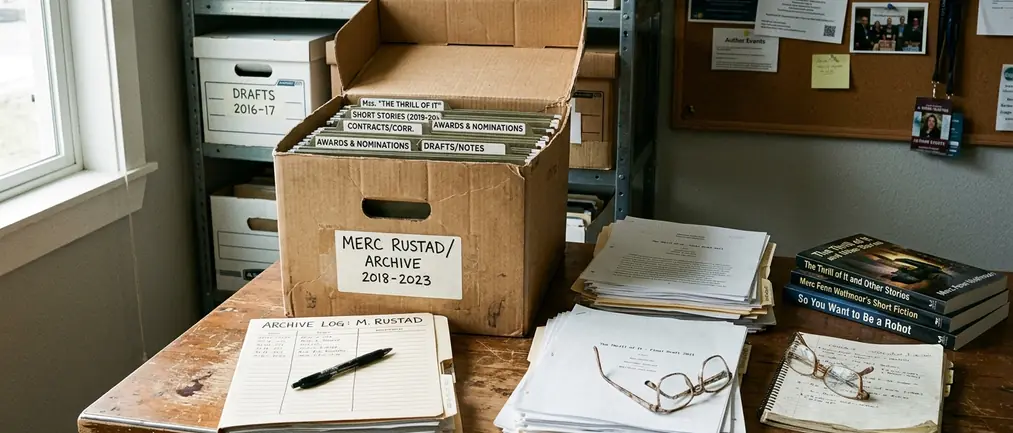
A bibliography-heavy interview can still fail if it treats awards, reprints, or appearances as proof of meaning rather than as context for circulation and reception. We must turn bibliography into interview preparation rather than résumé recitation.
Before the interview, verify the story title, publication venue, publication date, anthology or reprint title, and any award or appearance reference against current official materials. When researching A. Merc Rustad: author of numerous acclaimed speculative works, accurate tracking of these details ensures the conversation respects the timeline of their career.
For long publication histories or multiple public names, identify the period under discussion. Use phrases such as "early short fiction," "recent reprints," or "work published under a previous byline." This clarity helps the audience follow the author's creative evolution.
A highly useful bibliography question asks whether a piece changed between original publication and later reprint, rather than merely asking the author to list where it appeared. This shifts the focus from the accolade to the living text.
Scope, Limitations, and Questions to Avoid
The foundation of a strong interview is respect for the author's boundaries and the text's integrity. Authority signals such as publication credits, public appearances, and author-approved biographies have limits; they are time-bound and should be checked for current accuracy.
Fact checks for names, pronouns, publication credits, and public descriptions should be repeated after major site updates, new author bios, or recent public announcements. When interviewing Merc Rustad: author and essayist, relying on outdated summaries rather than current materials does a disservice to the living archive of their work.
Certain inquiries must be excluded entirely. Exclude intrusive medical or transition questions, requests to speak for an entire identity group, unverified award or publication claims, and questions based only on summaries.
While this guide can improve topic selection, it cannot replace consent, close reading, current author-approved materials, or direct communication when a factual or personal question is uncertain. Always return authority to the author.
End your interviews by opening the floor. A powerful closing prompt can be: "Is there anything about this work you wish readers asked more often?"