In this Article
- Key Takeaways for a Closer First Reading
- Why Contemporary SFF Short Fiction Rewards Slow Attention
- First Pass: Find the Story’s Contract With You
- Second Pass: Read for Compression, Pattern, and Craft Pressure
- Read the Genre Context Without Flattening the Story
- Use the Ending to Reread the Opening
- What Close Reading Can and Cannot Prove
- A Repeatable Routine for Your Next SFF Story
Key Takeaways for a Closer First Reading
Main Point: Close reading contemporary SFF short fiction is not a hunt for the one hidden meaning. It is a rereading practice that lets the story teach you how it wants to be read.
- Keep three note lanes: literal events, emotional response, and withheld information.
- Notice estrangement before explaining it.
- Track emotional shifts, especially where the prose changes temperature.
- Identify speculative rules before turning them into symbols.
- Watch compression: small details often carry world, class, law, desire, or danger.
- Return to the opening after the ending, because the first paragraph may change shape.
I use this as a method card, not a thesis preview. A reader should be able to finish the box above, open a story in Fireside: publication venue, an anthology, or a magazine archive, and have a workable sequence of attention before making any claim.
The first mistake I see is impatience dressed up as confidence. Someone finds an invented word, assigns it a symbolic meaning, and then forces the whole story to serve that early guess.
Slow down. Let the first read stay provisional.
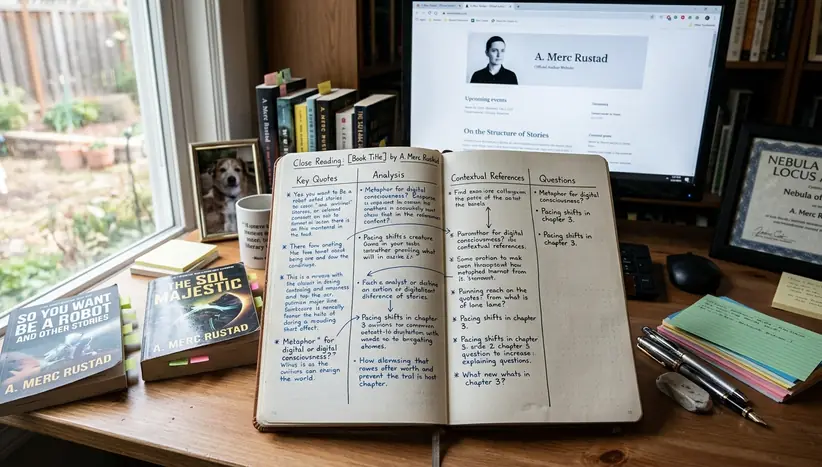
The three lanes I actually use
The literal lane records what happens. The emotional lane records where the story unsettles, charms, angers, or embarrasses you. The withheld-information lane records what the story declines to explain yet.
That third lane matters in SFF. An omission may be a craft problem. It may also be the pressure chamber where the story stores its politics, grief, or wonder.
Why Contemporary SFF Short Fiction Rewards Slow Attention
The density problem
Short SFF often has to build world, character, conflict, and thematic pressure inside the same sentence. A realist story can lean on shared assumptions about weather, medicine, money, family, and law. Speculative fiction may need to remake those assumptions while still moving the character through a scene.
That is why one compact unit can matter so much: an invented term, a ritual action, an altered body, a legal custom, or a piece of future technology. Treat these as load-bearing until the story proves otherwise.
A menu item can imply ecology. A pronoun choice can imply kinship. A bureaucratic form can imply empire. A spaceship maintenance detail can imply labor, class, and who gets to survive long enough to repair the hull.
Pleasure beyond plot solving
The pleasure is not only solving what happened. It is watching craft choices accumulate.
When I read short fiction commentary for A. Merc Rustad or Merc Rustad: author pages, I try to keep the page context close but not dominant. Venue, anthology theme, author note, and online publication date can help when they are available. They should not replace the sentence in front of you.
First Pass: Find the Story’s Contract With You
A common first question
The question I ask at the start is simple: what kind of attention is this story asking from me?
It may promise mystery, transformation, horror, wonder, grief, satire, romance, resistance, or revelation. Often it promises more than one. The trick is to name the dominant pressure without flattening the rest.
Take a hypothetical opening in which a city remembers its dead through weather. Rain recalls one generation. Fog recalls another. Heat, snow, or pressure changes bring back names the living have tried not to say.
Before interpreting that as grief, climate, ancestry, or civic guilt, identify the normalized impossibility: the city remembers through weather. That is the contract. The story has asked you to accept memory as atmospheric before you judge what the atmosphere means.
What to record before interpretation
- Who is speaking?
- What point of view governs the first scene?
- What tense shapes the reader’s sense of distance?
- What register does the prose use: intimate, ceremonial, bureaucratic, comic, devotional, clinical?
- Where does the first speculative signal appear?
Mark confusion during the first read, but do not classify it as a flaw until after the ending. Some stories clarify late. Some refuse clarity for a reason. Some simply overburden the reader. You need the whole shape before you can tell the difference.
Second Pass: Read for Compression, Pattern, and Craft Pressure
From beginner marks to sharper marks
On a second pass, I move from experience to pressure points. I use one annotation mark for worldbuilding facts, one for emotional turns, and one for unanswered questions. Nothing fancy. The system only needs to be repeatable.
Beginners often underline beautiful sentences. That is fine, but it is not enough. Ask what the sentence is doing under pressure.
- Does a repeated image change meaning each time it returns?
- Does an altered phrase reveal a new power relation?
- Does a symbolic object become more practical, or a practical object become symbolic?
- Does sentence rhythm tighten during fear, desire, or refusal?
- Does sensory language carry worldbuilding that exposition withholds?
Craft signals specific to SFF
Check naming systems, invented terminology, technological limits, magical costs, ecological conditions, and social taboos as separate signals. A failure case I have seen often: treating an invented term as decorative vocabulary instead of asking whether it encodes law, class, kinship, ecology, technology, or taboo.
Then ask a harder question. Does the speculative premise change at least one axis of agency, embodiment, memory, labor, kinship, ethics, or power?
If it does not, the premise may still produce mood or image. If it does, you have probably found one of the story’s central engines.
Read the Genre Context Without Flattening the Story
Comparison as a lens, not a label
Genre knowledge should sharpen attention. It should not end the conversation.
A reader may compare a story to first contact, portal fantasy, climate fiction, cyberpunk, fairy-tale retelling, space opera, body horror, or mythic revision. The useful sentence does not stop at the label. It names the conversation and then points back to a concrete feature: opening image, rule system, recurring object, narrative gap, or ending reversal.
For example: this story enters a climate-fiction conversation through its weather-memory rule, but its recurring pressure changes make mourning feel civic rather than private. That sentence can be argued with. Good. It has evidence in it.
Identity is not a puzzle key
Contemporary SFF often speaks through identity, marginality, queerness, disability, diaspora, empire, ecology, and labor. Read those pressures carefully. Do not turn them into a decoder ring.
The better question is how the story stages voice, risk, relation, access, embodiment, or power. A queer, disabled, diasporic, or otherwise marginalized context should not become a shortcut around the prose. It should make you more responsible to the prose.
If your notes include a title such as The Collars We Wear, resist letting the title do all the interpretive work. Track who wears, who names, who fastens, who refuses, and what the story withholds around those actions.
Use the Ending to Reread the Opening
The loop that changes the first page
Many short speculative stories become legible in retrospect. The ending often changes what the first paragraph means.
Return to the first line, first image, or first impossibility. Then compare it with the final emotional or conceptual turn. Do this before rereading the middle.
In the weather-memory example, the first paragraph may look like worldbuilding on first read. After the ending, it may look like accusation, inheritance, mercy, or a public record written in air.
Four questions for the return
- What changed?
- What did I misunderstand?
- What was hidden in plain sight?
- What does the final image ask me to carry forward?
Separate plot resolution from emotional resolution. A story may close one and leave the other open. It may resolve the mystery and keep the grief raw. It may liberate the character and destabilize the reader.
Ask whether the ending resolves, reframes, refuses, wounds, liberates, or deliberately unsettles the central question. Those verbs produce different readings.
What Close Reading Can and Cannot Prove
Evidence before authority
Close reading supports evidence-based interpretation, but it does not guarantee authorial intention or settle every plausible reading. That limit is not a weakness. It keeps the work honest, especially with stories built from withholding, where a neat reading can arrive too early.
Use quotation or precise paraphrase for any major interpretive claim. If you cannot point to language, structure, recurrence, omission, or reversal, the claim may be interesting, but it is not yet grounded.
I separate three claims in my notes:
- What the text demonstrates.
- What I infer from that evidence.
- What remains uncertain.
Context can move
Do not overclaim from biography, award status, community reputation, or assumed identity position. Those contexts may matter. They do not excuse sloppy reading.
Reception can shift between the original publication moment, later classroom use, reviews, and award discussion. A story published in a themed anthology may signal a conversation before the first sentence. A standalone online publication may require the reader to build context mostly from the prose itself.
Caution: If your interpretation depends more on what you know around the story than on what the story actually stages, return to the page and rebuild the claim.
A Repeatable Routine for Your Next SFF Story
The five-step pass
- Read once for experience. Let the story happen before you manage it.
- Summarize the literal plot in a few plain sentences.
- Mark the speculative rules, especially the first normalized impossibility.
- Reread for patterns: images, phrases, objects, rhythm, silence, and return.
- Write one evidence-based interpretation that names both claim and uncertainty.
This routine is short enough for an online story, a magazine issue, an anthology selection, or a classroom reread. It also prevents the most common rush: moving from vibe to verdict with no middle step.

A note template that holds up
- Title
- Venue and date, if available
- First speculative signal
- Central emotional shift
- Recurring image
- Unresolved question
- Final interpretive claim
The template looks modest. That is the point. It leaves room for strangeness without pretending every story needs the same answer.
Expert Tip: If a story feels opaque, reread only the first page and final page together before returning to the middle. The hinge often appears when the opening and ending sit side by side.
Close reading, at its best, trains patience without killing surprise. Contemporary SFF short fiction rewards that patience because it often hides its largest pressures in the smallest units: a name, a custom, a weather change, a cost paid in passing. Read once for the spell. Then read again for the machinery that made the spell feel alive.