In this Article
- What a useful author bio does, and what it should leave alone.
- How to choose a 25-word, 50-word, 100-word, or press-kit bio before sorting facts.
- How to handle bylines, selected credits, awards, grants, residencies, and appearances without blurring claims.
- How to keep publication credits checkable across author sites, award packets, interviews, and convention programs.
- How to maintain dated versions so old introductions stay intelligible and current bios stay current.
Key Takeaways for Busy Editors, Reviewers, and Event Hosts
Main Point: A strong author bio is not a life story. It is a context tool for publications, convention programs, award packets, classroom syllabi, and interviews.
- Start with the current byline, not the oldest or most decorated form of the name.
- Use relevant publication credits, selected for the reader in front of you.
- State award, grant, residency, and appearance notes in checkable language.
- Add a current as of Month Year line when the bio includes recent reprints, podcast adaptations, anthology placements, award eligibility, or byline changes.
- Keep the bio shorter than the bibliography. Let each do its own work.
I keep seeing the same small problem cause large irritation: a bio tries to persuade before it helps. Editors need copy they can paste. Reviewers need context they can trust. Educators need enough publication detail to cite the work correctly.
That means the decision order is audience need before prestige. If the bio names A. Merc Rustad: author, or Merc Rustad: author, it should do so because that is the useful identity marker in the given context, not because every possible credit must be pulled into one paragraph.
Choose the Bio Length Before You Choose the Facts
The common question
How much should an author bio say?
Less than the author usually wants, and more precisely than the host usually receives.
The practical answer
- 25 words: best for program schedules, panel grids, reading lineups, and caption-style contributor listings.
- 50 words: best for magazine contributor notes, anthology back matter, and reviewer background blurbs.
- 100 words: best for interviews, teaching packets, syllabus notes, and longer reviewer context.
- 150 words or longer: best for press kits, author pages, and media packets where selected credits and appearance roles can be separated.
A 25-word convention listing can mention genre, byline, and one selected context. A teaching packet may need publication year, format, and stable citation details. Those are different containers, so they should not draw from the same sentence with words merely cut away.
First person, third person, or neutral language
First person works well on an author site or interview sheet when the surrounding page already feels conversational. Third person fits contributor notes, convention programs, award packets, and classroom materials. Neutral descriptive language helps when the bio is really metadata: name, role, selected works, and current credit scope.
Expert Tip: Write the 50-word version first. It forces selection, but still leaves enough room for byline, genre, selected credit, and one useful thematic phrase.
Build a Core Author Bio from Stable, Verifiable Details
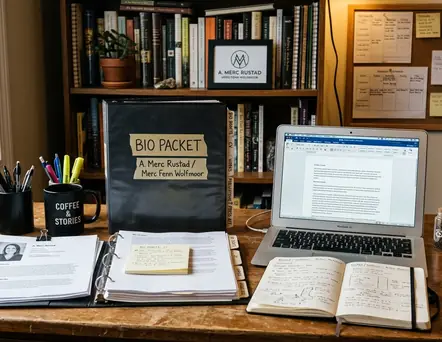
The durable bio starts with facts that will still matter after a single publication cycle: name or byline, genre area, selected works, recurring themes, and professional context. In my archive work, the bios that age best are not the longest ones. They are the ones with clean seams.
Keep the core file to roughly 5 to 8 reusable fact units:
- Name or byline.
- Genre field, such as speculative fiction.
- Selected publications or publication venues.
- Selected books, stories, or projects, such as The Collars We Wear when it fits the page context.
- Recurring themes, for example transformation, memory, body, myth, or identity.
- Award, grant, residency, or appearance context when documented.
- Pronouns if publicly shared.
- Contact boundary if relevant.
For authors who publish under more than one name, byline continuity needs care. A phrase such as A. Merc Rustad / Merc Fenn Wolfmoor can describe a site or public identity path, but it should not imply that every publication used both credit lines. The credit itself should preserve the byline used at the time.
This is where selected credits matter. Under 100 words, a bio should not list every appearance. It should choose the credits most useful to the reader: a recent anthology for reviewers, a relevant magazine for editors, or a stable work title for educators.
Format Publication Credits So They Can Be Checked
The credit format should serve verification, not ornament. Start with the work title, then add the publication venue, editor or publisher when relevant, publication year, and format.
A private master bibliography can hold more than the public page
- Title.
- Byline used.
- Original venue.
- Editor or publisher.
- Publication month if known.
- Publication year.
- Format.
- Rights or reprint status if tracked.
- Link.
- Archived source note.
- Public-credit wording.
Public selected bibliographies should separate originals, reprints, podcast or audio versions, translations, and anthology appearances when a story has several lives. SFF short fiction often travels: original web publication, later reprint, then audio adaptation. If the same story appears three times without labels, a reader may mistake one work for three original works.
Use a structure like this:
- Original publication: [Story Title], [venue], [year].
- Reprint: [Story Title], [anthology or collection type], [year].
- Audio adaptation: [Story Title], [podcast or audio venue type], [year].
Consistency matters across author websites, award packets, interviews, and convention bios. A credit that reads one way on the site and another way in an award packet creates avoidable doubt, especially when the venue name, date, or format shifts. If a note says Fireside: publication venue in the master file, the public version should still make clear whether the appearance was original, reprint, or another format.
Write Award, Grant, Residency, and Appearance Notes Without Overclaiming
Begin with the documented status. Was the work a winner, finalist, nominee, shortlist entry, longlist entry, eligibility listing, grant recipient, residency participant, invited guest, or program participant?
Those words are not interchangeable.
The minimum award-note structure is: status, award or honor type, category, work title if applicable, year, and source wording. For formal materials, check category names against primary award materials. For the Hugo Awards, for example, the official Hugo Awards rules are the better reference point than memory or social shorthand.
Caution: Do not turn eligibility into nomination, nomination into finalist status, or finalist status into a win. The compression may look elegant, but it weakens the record.
Use language like:
- Finalist for [award], [category], [year].
- Winner, [award], [category], for [work title], [year].
- Grant recipient, [grant type], [institution or program scope], [year].
- Residency participant, [program], [season or year].
Appearance notes need the same discipline. State the role, format, host type, month or season if public, year, and whether the author appeared as panelist, reader, interviewer, instructor, keynote speaker, workshop leader, or guest of honor. A panel is not a keynote. A recorded conversation is not a residency. Precision is kinder to everyone downstream.
Prepare Different Versions for Editors, Reviewers, Educators, and Conventions
Each user is trying to solve a different problem. Editors need clean contributor copy they can paste without repair. Reviewers need context. Educators need stable citation details. Convention organizers need concise program language that survives grids, apps, and print layouts.
A compact author media packet should include:
- 25-word bio.
- 50-word bio.
- 100-word bio.
- Selected credits.
- Pronunciation or name-use note if desired.
- Current pronouns if publicly shared.
- Preferred contact route.
- Boundaries around unavailable personal details.
Keep a plain-text version with no tables, tabs, footnotes, smart formatting, or embedded links for submission forms that strip styling. This sounds fussy until a contributor note lands in a form field that eats italics, punctuation, and hyperlinks. Then plain text becomes relief.
Match the version to the recipient
- Editor: short contributor note, current byline, one or two selected credits.
- Reviewer: medium bio, genre context, selected works, and relevant publication history.
- Educator: stable citation details, publication year, format, and byline used.
- Convention organizer: 25-word or 50-word bio, appearance role, pronunciation or name-use note if shared.
Appearance records should distinguish panel, reading, interview, keynote, workshop, guest-of-honor role, teaching visit, and recorded conversation. The distinction is not vanity. It is description.
Scope, Dates, and Limitations: What a Bio Cannot Prove
This section slows the hand before the bio gets treated as evidence. A public author bio can responsibly summarize career context, but one catch: it cannot serve as an independent bibliography, legal identity record, award database, or proof of continuing institutional affiliation.
Use current as of Month Year near the bio or selected bibliography when the page includes time-sensitive credits. That small date helps readers understand whether a recent reprint, adaptation, anthology placement, award note, byline shift, pronoun update, institutional role, or safety boundary has been folded into the current wording.
For formal decisions, verify award category names, eligibility periods, publication metadata, and institutional roles through primary sources. Review identity, location, institutional, and contact details before each public reuse, especially after a byline, pronoun, affiliation, or safety-boundary change.
Main Point: The bio points toward the record. It does not replace the record.
Before-and-After Examples for Cleaner Bio Copy
The goal is not to drain the prose of warmth. The goal is to remove fog from the claims.
Vague prestige copy
Award-winning writer with many stories online.
The problem is not tone. The problem is that almost nothing can be checked. Which award? Which status? Which stories? Which venues?
Cleaner version
Speculative fiction writer whose selected short fiction has appeared in genre magazines, anthologies, and audio venues; finalist for [award type], [category], [year].
Short contributor note model
[Name] writes speculative fiction exploring transformation, memory, body, and myth. Their selected short fiction has appeared in [venue type] and [anthology type]. Current as of Month Year.
Convention program bio model
[Name] writes speculative fiction and appears on panels about short fiction, mythic transformation, and literary metadata. Their selected work includes [selected credit].
Award packet note model
[Work Title], by [Byline Used], first appeared in [venue], [year]. Status: finalist for [award], [category], [year], using the category wording from the award source.
If the only documented record is that one story appeared on an eligibility list, do not call the author award-winning. Name the status, category, work title, and year. The clearer sentence may be less shiny, but it will survive contact with an editor, a teacher, or an awards administrator.
Maintenance Workflow: Keep the Bio Current Without Rewriting It Every Time
Maintenance belongs inside the publication workflow, not in a neglected publicity folder. After each new story, reprint, audio adaptation, interview, award announcement, teaching invitation, or public appearance becomes official, update the master file within roughly a week.
That window matters because the memory is still fresh, the announcement language is still easy to find, and the public wording has not yet drifted into five copied versions.
Bio and Credit Maintenance Checklist
- Add the date the credit became public or official.
- Record the venue, publisher, host, or institution type without inflating the relationship.
- State the role: author, contributor, editor, finalist, winner, panelist, reader, interviewer, instructor, keynote speaker, workshop leader, or guest of honor.
- Label the format: original publication, reprint, podcast, audio adaptation, translation, anthology appearance, interview, panel, or teaching visit.
- Update the public selected bibliography after each new publication, reprint, adaptation, or anthology placement.
- Store old bios with date labels so archival introductions, interviews, and program copy can be understood in context.
Schedule a twice-yearly review to remove stale affiliations, retired program language, outdated pronouns, superseded bylines, dead links, and credits that no longer fit the selected-bio purpose. This is not glamour work. It is the quiet hinge between literary presence and archival reliability.