
Day 1: Carrying Messages Between Fragments
Fragmented SFF creates intimacy by making readers responsible for carrying a message between disconnected voices.
- Document formats determine who can speak.
- Missing responses can carry emotional weight.
- Timestamps can make technical systems feel personal.
That is the critical argument guiding this reading itinerary, rather than an established finding about reader psychology. Over seven days, we will move through logs, letters, interrupted sequences, and the work their gaps ask readers to do.
I find the most revealing moment often comes when a document exceeds its assigned purpose: a maintenance field becomes an appeal, or a revised signature changes the stakes of an unsent message. Readers may recognize that small catch before they can explain its mechanics.
Start there. Ask what the document permits its speaker to say, then notice where the speaker presses against that permission. The itinerary follows those pressures chronologically, from identifying a format to deciding what its unanswered address makes possible.
Day 2: Locating the Log, the Letter, and the Break
Does every story containing a letter count as epistolary? For this reading exercise, the useful question is whether communications organize the story. A letter quoted inside otherwise continuous narration may have a very different structural role from letters that provide the only access to events.
Epistolary storytelling organizes a narrative through communications. A log records successive entries. Fragmentation interrupts continuity. These principles overlap: a log can be fragmented, and a correspondence can proceed with considerable continuity.
Keep their audiences distinct:
- A private log may address a future self or a record keeper.
- An unsent letter invokes a particular absent recipient.
- A message exchange exposes unequal knowledge, access, or opportunities to answer.
These are working distinctions for close reading, with room for stories that complicate them.
Our coordinates are textual: entry timestamp, document order, sender, intended recipient, and the reader’s position in the sequence. The first document presented may describe the latest event. A reply may disclose something its preceding message concealed. Record both what a document says and what you already know when you encounter it; that difference helps explain why the same sentence can reassure on a first reading and disturb on a second.
Day 3: Watching a Maintenance Log Become an Appeal
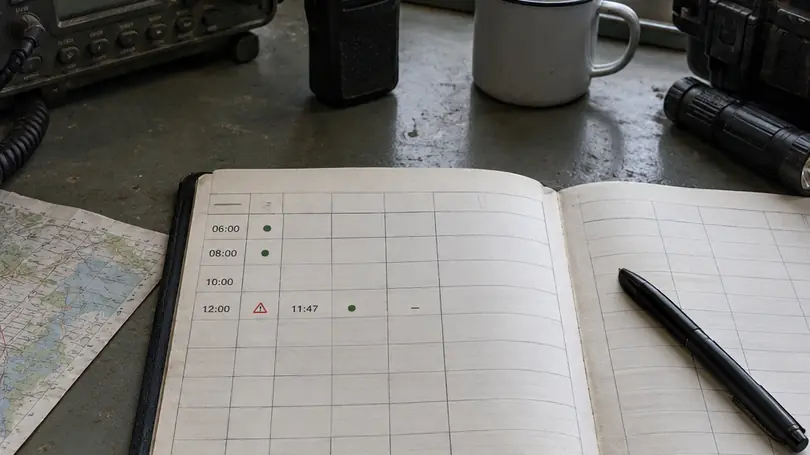
Consider a constructed teaching example, not a published story or quotation. A spacecraft maintenance log uses five fields: event time, recording time, equipment status, crew contact, and action taken.
The 06:00 and 08:00 entries complete those fields routinely. They establish a two-hour reporting rhythm. The expected 10:00 entry is absent.
At 12:00, the log records a storm warning with an event time of 11:47. Equipment status remains “nominal.” Crew contact is blank. The action field reads: “Left your channel open. You can still answer here.”
Where the Action Field Changes Its Audience
The equipment vocabulary stays steady while the address changes. “Left your channel open” begins turning a procedural record toward a particular listener. “You can still answer here” makes that turn explicit. Someone who began by documenting actions now uses the record to keep a relationship available.
The blank crew-contact field matters beside that appeal. It gives the reader a silence to carry into the next sentence. Meanwhile, the storm warning names an external danger; the recorder expresses fear indirectly through the open channel.
Timing supplies another distinction. The warning belongs to 11:47; its recording belongs to 12:00. That interval separates an event from the act of preserving it, without establishing why the recorder waited.
The missing 10:00 entry becomes legible because the earlier entries establish a schedule. Its cause remains unresolved. A missing report alone establishes neither trauma nor deception. The close-reading task is to identify the broken pattern before assigning it a motive.
Day 4: Reading the Letter That Stays in Drafts
What changes when a document begins with someone particular already in mind?
Take a second constructed teaching example. A speculative traveler drafts a letter to someone they cannot reach. The first version reports their location. A revision deletes that location. A later revision restores a chosen name previously omitted from the signature. The message remains in drafts.
This sequence gives us changing decisions about disclosure. It does not yet tell us what the recipient knows.
Four Stages of an Unfinished Exchange
- Writing creates a record.
- Sending initiates transmission.
- Delivery establishes arrival at a destination.
- Acknowledgment supplies evidence of a response.

Each stage leaves a different absence. A draft withholds the message before transmission. An unacknowledged delivery leaves open what happened after arrival. Uncertainty about a recipient’s survival differs from uncertainty about whether they would welcome a disclosure.
Deleting the location might protect the recipient, preserve privacy, conceal danger, or express shame. Surrounding characterization must support the choice among those readings. Restoring a chosen name changes what the traveler is prepared to disclose. A queer or nonbinary reading needs further textual context; the signature alone cannot establish identity or recognition.
Compare the letter with the maintenance log. The log begins by preserving an accountable record and gradually seeks a listener. The letter begins with that listener already present in its imagined address. Revision lets the reader witness the distance between wanting recognition and making recognition possible.
Day 5: Reconstructing Events Without Closing Every Gap
On a first encounter, follow the documents in their presented order. Let the sequence disclose information at its chosen pace. On a second pass, reconstruct the likely event order and compare the two.
A small working list is enough:
- Document position
- Stated time
- Speaker
- Recipient
- Information withheld
Leave an unknown field visibly unresolved. Filling every blank can erase the very uncertainty the story has arranged.
A Second Pass Through the Missing Report
- Preserve presented order. Note when the reader encounters each report or revision.
- Reconstruct events. Separate event time from recording time wherever the text permits.
- Mark missing exchanges. Identify the pattern that makes an absent entry or reply noticeable.
- Attach inferences to evidence. Name the document or phrase supporting each interpretation.
- Keep speculation separate. Retain possibilities without promoting them to events.
In the log, the scheduled 10:00 report is missing. A failed rescue remains speculative. In the letter sequence, draft status establishes that this version was not sent. It cannot establish that every possible route of communication has failed.
Productive uncertainty gives readers enough recurring information to recognize what an absence changes. Simple disorientation leaves them unable to identify the relationship or sequence at stake. Failed delivery describes a mechanism; loneliness needs support from characterization, repeated choices, or the language of address.
For writers and editors, try a further test: temporarily remove the document headers. Record which timing distinctions, relationships, or revelations disappear. If comprehension remains unchanged, the headers may be doing little structural work.
Day 6: Testing the Claimed Rise in Fragmented Magazine Fiction
The proposed five-year increase in fragmented magazine fiction remains unestablished here. No named publication dataset, verified award corpus, or comparable historical baseline has been supplied. The reading argument can stand without turning a visible formal technique into a market trend.
A defensible comparison would require:
- A fixed five-year date window
- Named magazines and consistent story-inclusion rules
- A stable definition of document-based storytelling
- A denominator containing all eligible stories
- A comparable earlier baseline using the same rules
That definition matters. Counting every story that contains a message would measure something different from counting stories whose communications organize the narrative. Changing the definition between periods would weaken the comparison before any conclusion emerged.
Publication frequency also differs from visibility. A memorable document-built story can occupy considerable space in a reader’s recollection. Editorial circulation and award attention may increase its visibility without demonstrating a market-wide increase. Award-nominated fiction is a selected subset, rather than a representative sample of all magazine fiction.
Published examples need their own verification: author, original venue, publication date, and relevant passage, with any award status checked separately. Until that work exists, the precise claim concerns what a particular structure does on the page. That is already a substantial critical question.
Day 7: Asking Who Can Answer the Fragment
Recording an event and reaching another person are separate acts. The maintenance log makes that separation painful when its procedural field begins speaking to an unreachable crew member. The traveler’s letter approaches it from the other direction: a specific recipient shapes every revision, although the message remains unsent.
Readers hold the connections these fictional systems leave incomplete. We can place the empty contact field beside the appeal. We can recognize that restoring a signature changes the traveler’s intended disclosure without inventing a reply. Fragmentation creates the opportunity for intimacy through this careful carrying of information between documents.
That reading asks for attention rather than compulsory certainty. The missing report matters because a rhythm prepared us to notice it. The restored name matters because revision makes disclosure an action. Neither requires us to manufacture an ending beyond the page.
Carry one question into the next magazine story: Who is this document for, and what prevents it from reaching them?
Read every fragment as an attempted relationship before treating it as a puzzle to solve.