In this Article
- Key Takeaways: The Fast Route Into Merc Rustad’s Work
- A Reading Map by Theme, Not Publication Date
- For Readers Who Found “it me, ur smol” First
- Found Family, Gender Choice, and Portal-Like SFFH
- Robot Dinosaurs, Short Film, and Interactive Space Opera
- Queer, Trans, and Nonbinary Currents in the Fiction
- Early Horror, Loneliness, and Recurring Motifs
- Byline Context, Scope, and Limits of This Guide
- Suggested Reading Pathways
Key Takeaways: The Fast Route Into Merc Rustad’s Work
Main Point: The opener should function as a routing panel rather than a miniature biography. The decision is to sort Rustad’s work by reader need—so someone arriving for queer SFF, found-family fantasy, robot dinosaurs, horror imagery, interactive fiction, or experimental internet voice can immediately find their footing.
- "This Is Not A Wardrobe Door" is the recommended first stop for found-family fantasy.
- "The Android’s Prehistoric Menagerie" is the recommended first stop for android-and-dinosaur whimsy.
- "Iron Aria" is the recommended first stop for queer/trans SFF.
- "it me, ur smol" is the recommended first stop for AI-persona and internet-voice experimentation.
This guide is organized by reading pathway rather than strict bibliography. Readers, editors, reviewers, educators, and convention organizers can quickly find relevant works without parsing a chronological list.
A Reading Map by Theme, Not Publication Date
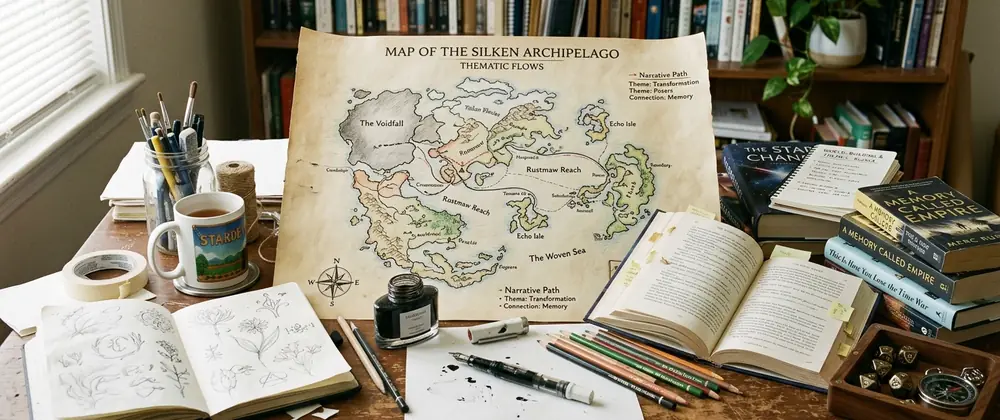
A common question I receive from educators building syllabi is how to sequence an author whose output spans multiple formats. In my work building structured editorial frameworks for author bibliographies, I frequently encounter the friction between publication dates and thematic resonance. A strict chronology was considered and discarded.
The guide is built as a thematic map because Rustad’s bibliography crosses short fiction, essays, film, interactive fiction, crowdfunding-driven publishing, and author notes. The recurring thematic clusters to track are chosen kinship, constructed identity, altered embodiment, loneliness, resistance, and tenderness inside speculative or horror-inflected settings.
We must also account for digital discovery. The backlink signal around "it me, ur smol" indicates that many readers arrive through a single viral or forum-shared post. We should treat that story as a possible single-entry gateway, helping those readers branch into related fiction.
For Readers Who Found “it me, ur smol” First
Many readers begin their progression path here. "it me, ur smol" serves as an accessible entry into Rustad’s interest in artificial intelligence, persona, language, and playful digital intimacy.
The piece describes an Artificial Neural Network and uses language protocols as part of persona creation. The fictional Twitter account named in the story context is @energydrinkANN. Inspired by Alina S., the story was published on March 30, 2018, and carries 2018 copyright context.
Moving beyond surface accessibility reveals deeper craft. The playful digital voice connects to broader Rustad concerns regarding nonhuman consciousness, self-naming, online voice, and the emotional charge of constructed identity. A generic overview that says Rustad writes inclusive speculative fiction but omits the March 30, 2018 publication context, @energydrinkANN, Alina S. inspiration, or the Artificial Neural Network framing of "it me, ur smol" would flatten the internet-persona craft that makes the piece distinctive.
Found Family, Gender Choice, and Portal-Like SFFH
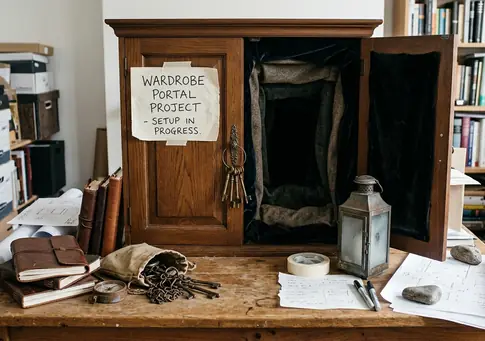
Expert Tip: Found family should be defined here as kinship chosen regardless of biological origin, not merely as a cozy or comforting trope.
I pair an emotionally direct found-family story with a brighter android story to show range without losing the through-line of chosen kinship and self-definition. "This Is Not A Wardrobe Door" acts as the central discussion point for found-family and gender-choice themes. It was published by Fireside on January 4, 2016. The relevant submission-window context for this piece is late 2014.
Pair it with "The Android’s Prehistoric Menagerie," which appeared in Mothership Zeta Issue #2 on February 8, 2016. This pairing demonstrates Rustad’s range from emotionally grounded SFFH to android-and-dinosaur playfulness.
Robot Dinosaurs, Short Film, and Interactive Space Opera
The cross-media section should be organized by production form: anthology project, short film, and interactive fiction. That lets the reader see Rustad not only as a short-fiction writer but as someone working across visual and interactive spaces.
Robot Dinosaur Fiction! was a 2018 virtual anthology project led by A. Merc Rustad. The crowdfunding launch date was April 24, 2018. Weekly flash fiction was scheduled from May through August 2018. Vina Jie-Min Prasad contributed a bonus story to the project, and Kelsey Liggett created the banner art. These details provide project-specific collaboration context rather than standalone name-dropping. The robot dinosaur material should not be treated as a single joke premise; it splits across this virtual anthology and a broader pattern of playful nonhuman embodiment—one that extends into interactive formats.
CLICK is a short film directed and edited by Merc Rustad. It was filmed originally in November 2013, delayed by sound-recording issues, and completed with final edits in December 2014 before being hosted on Vimeo.
For those exploring the interactive space opera elements, understanding the underlying mechanics is helpful. You can review the ChoiceScript introduction from Choice of Games to see how these branching narratives are constructed.
Queer, Trans, and Nonbinary Currents in the Fiction
When I map speculative fiction taxonomies, I look for structural anchors. According to publication data, these currents function as literary structure rather than a label pasted over the bibliography. The works are best grouped by how they handle embodiment, representation, and genre mood.
"Iron Aria" is discussed as ownvoices queer/trans SFF. It appeared in Fireside Issue 34 in July 2016, with Galen Dara as the illustrator. This provides both publication and creative context.
"Exponentially Hoping" and "Finding Home" share March 2015 Vitality Magazine publication context. "Exponentially Hoping" is tied to non-binary representation, while "Finding Home" uses alternate realities within positive SF. "Monster Girls Don’t Cry" serves as a later related touchpoint, published in Uncanny Magazine in January 2017 with John Picacio’s "El Arpa" cover artwork.
Early Horror, Loneliness, and Recurring Motifs
In our reading group, we noticed that the darker early pieces help explain why later stories about chosen identity, creatureliness, and survival often carry a sharp edge. The horror section should be used to complicate the entry-path version of Rustad’s work.
"All the Little Animals" is the central text for Rustad’s horror register in this section. It includes semi-autobiographic imagery in its author-context framing. The story was published in The Red Penny Papers in Spring 2013. The author’s 2009 viewing of Night Gallery belongs to the context for this piece.
"With the Sun and the Moon in His Eyes" appeared in the RIDE THE MOON anthology context in February 2012, highlighting loneliness and blinding as recurring motifs. These darker works deepen the reader’s understanding of the broader bibliography.
Byline Context, Scope, and Limits of This Guide
Caution: A chronology-only bibliography would bury useful entry points for readers who need a route into found family, queer/trans SFF, horror motifs, or interactive fiction.
A. Merc Rustad is the professional fiction byline used in this guide. Merc is the author’s chosen name. The "A" has been discussed in relation to Android as an identity marker in a February 4, 2016 article. This separates practical identification from exhaustive bibliography.
Publication venues, collaborators, and dates appear only where they clarify scope, chronology, or format. Because this guide relies strictly on the supplied publication history and author-site context, it does not represent an exhaustive critical survey or a complete awards record.
Suggested Reading Pathways
The final step is converting the thematic map into usable routes for distinct audiences. New readers need momentum and tonal variety. Reviewers and award readers need comparative clusters. Educators require format diversity.
- New readers should begin with "This Is Not A Wardrobe Door," then continue to "The Android’s Prehistoric Menagerie" and "it me, ur smol."
- Reviewers and award readers should pair "Iron Aria," "Monster Girls Don’t Cry," and "Finding Home" to trace representation, genre mood, and speculative structure.
- Convention organizers and educators should use Robot Dinosaur Fiction!, CLICK, and Galactic Bounty Hunter to highlight cross-media range.