Key Takeaways: The Nonhuman Heart Is Not a Costume
Main Point: Nonhuman characters work best when their emotional logic is specific, not merely human emotion wearing a mask. The decision here is to make emotional specificity the governing principle. A character's feeling should arise directly from their material reality, rather than serving as a taxonomy of robots, monsters, and aliens.
Robots, monsters, aliens, and other nonhuman beings need desires, limits, sensory worlds, and forms of care that arise from what they fundamentally are. To achieve this, writers must commit to the following craft positions:
- Resist default human psychology and build emotional responses from the character's unique ontology.
- Build embodiment first, letting physical constraints dictate psychological needs.
- Make language carry difference through deliberate syntax, metaphor, and sensory priority.
- Let monstrosity be ethical rather than decorative, giving the creature stakes that matter to its own survival.
- Preserve mystery by allowing certain aspects of the nonhuman mind to remain resistant to human understanding.
My Argument: Make the Strange Emotionally Exact
I am less interested in whether a robot can feel like us than in whether the story understands what feeling would mean for that robot. As an editorial strategist working with speculative fiction taxonomy, I approach this as craft commentary rather than a universal rulebook. Emotional truth does not require biological sameness or familiar human reactions.
Speculative fiction's core promise relies on its ordinary tools: invented minds, altered bodies, estranged social forms, and unfamiliar systems of value. Genre lets writers invent minds without flattening them into metaphors. When reading A. Merc Rustad's fiction, particularly stories published in venues like Fireside, you see a masterclass in this exact discipline. In works like The Collars We Wear, the emotional architecture of nonhuman or altered beings is exact, rigorous, and deeply moving because it refuses to take human emotional defaults for granted.
The Common Mistake: Humanity as the Default Setting
Writers often design the surface first and retrofit ordinary human psychology underneath it. Treating horns, chrome, wings, tentacles, or unusual pronouns as mere additions applied afterward weakens reader engagement. The concept may look imaginative on the page, but the emotional architecture feels generic.
In my editorial group, we frequently see manuscripts where this shortcut undermines the premise. We once reviewed a project where a robot narrator claimed to experience memory as archived retrieval, but every scene treated memory like ordinary nostalgic childhood recollection. There was no maintenance cost, permission structure, data loss, update conflict, or repair dependency. The failure case is highly visible at the sentence level when a supposedly alien or artificial being uses the exact same emotional priorities and social assumptions as the surrounding human cast.
I acknowledge why writers do this. Human emotion is accessible, efficient, and often commercially legible. The commercial pressure to keep motives instantly understandable is real, but it should not excuse flattened characterization.
Begin With Body, System, Hunger, and Constraint
Order the craft process from material condition to personality. You must define the being's body, operating system, appetite, sensory range, permissions, dependencies, and hazards before defining their personality.
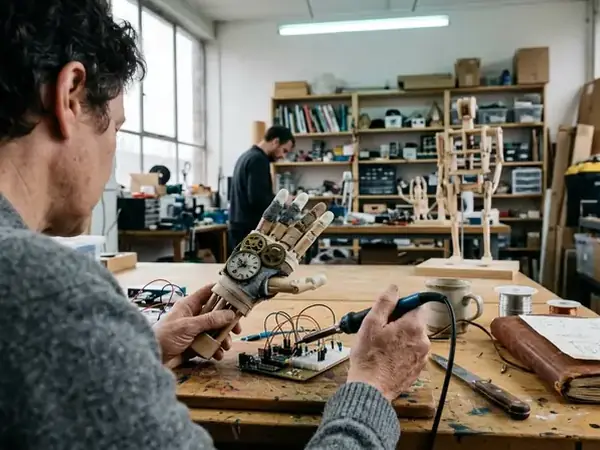
For a robot, test maintenance, memory access, sensory inputs, permissions, upgrades, repair dependency, shutdown conditions, and obsolescence before drafting dialogue. If a machine requires a proprietary charging port controlled by a hostile corporation, its concept of loyalty and fear will be shaped entirely by that dependency.
For a monster, test appetite, scale, transformation, territory, vulnerability, fear response, and the cost of attachment. A creature that must consume memories to survive will view a crowded room very differently than a human does.
For an alien or stranger entity, test time perception, reproduction, kinship, death, communication, and whether individuality is even the right unit of character. If a species experiences time non-linearly, grief becomes a completely different mechanism.
Let Language Reveal the Shape of the Mind
Voice is the place where ontology becomes readable. The decision is not to make the prose weird for its own sake, but to let syntax, metaphor, silence, repetition, sensory priority, and omission do the heavy lifting. A nonhuman consciousness should feel distinct in its very construction.
Expert Tip: Conduct a practical revision pass by examining one page of the character's narration or dialogue for borrowed human metaphors. Look for casual references to hands, hearts, faces, hunger, childhood, ownership, home, cleanliness, and time. If your plasma-based entity describes a situation as "heartbreaking," you have breached their perspective.
I warn against gimmick language that becomes unreadable or merely decorative. You must balance estrangement with comprehension. Readers need enough footholds to care, but not so many that the character becomes conventionally human. Readable estrangement can be built by keeping plot consequence clear while allowing perception, value, and metaphor to remain partially unfamiliar.
A Monster Should Not Exist Only to Teach a Human Lesson
Monsters are often reduced to symbols of trauma, queerness, rage, contamination, or social fear. Metaphor is undeniably powerful in speculative fiction, especially for marginalized experience. However, the flattening version of this trope is deeply harmful to narrative integrity.
Caution: A common failure case occurs when a monster is called unknowable, yet exists only to reveal a human protagonist's compassion, fear, or prejudice. Once the human lesson is complete, the monster has no remaining desire or consequence. If the monster only functions as someone else's lesson, it has no interior life.
A useful test is to remove the human observer from the scene entirely—ask what the monster still wants, protects, fears, refuses, remembers, or misunderstands. The monster's stakes should include at least one consequence that matters to its own survival, dignity, kinship, territory, appetite, transformation, or freedom.
The Limit: We Cannot Fully Escape the Human Lens
Total alienness is not a realistic craft target in narrative fiction. Every nonhuman character on the page is still mediated by human language, genre expectation, publishing context, and reader interpretation. Perfect alienness may be impossible, or at the very least, entirely unreadable.
The better goal is disciplined estrangement. This requires deliberate choices about which aspects of the character become legible and which remain resistant. We must distinguish emotional truth from total comprehensibility. Context-dependent variation matters here. A comic or fairy-tale mode may intentionally use broad symbolic creatures, while a psychologically intimate novella may need sharper sensory, ethical, and linguistic differentiation.
Keep the Heart, But Change What a Heart Can Be
Nonhuman characters do not need to become human to move us. Robots, monsters, and other beings can have hearts if the writer reimagines what a heart means in the context of their existence.
We can create care, grief, desire, loyalty, rage, or wonder through nonhuman conditions rather than despite them. The ultimate craft challenge for writers is this: make the reader care without making the character ordinary. Preserve the strange, honor the constraints of the body you have built, and let the emotional truth emerge from the specific reality of the being you have brought to life.