Let Unfamiliar Pronouns Carry the Action
Unfamiliar pronouns can accelerate a scene when readers meet them through consequential action. In speculative fiction, writers should prioritize character tracking and narrative stakes over an introductory explanation of the entire language. If a sentence forces the reader to parse a new morphological paradigm while nothing in the room moves, the scene stalls. When the form is bolted directly to physical risk or interpersonal leverage, the eye parses the grammar because it needs to know who holds the doorway.
We can define two operational terms for this architecture: a referent is the specific person a grammatical form points to, while stakes represent what an action can preserve, cost, or change. Consider an original demonstration:
Selen caught the departing shuttle’s handrail. Xe passed the antidote through first.
Naming Selen in the opening clause establishes the sole plausible actor. Passing the antidote before climbing aboard gives the second sentence an immediate narrative consequence that extends beyond merely demonstrating how a subject pronoun functions. Readers of queer speculative fiction and other genre fiction decode unfamiliar terminology every time they open a new book. They map xe to Selen through syntax and causality. While these English-facing demonstrations offer line-level revision techniques rather than a universal reading-speed guarantee, grounding an unfamiliar form in physical causality remains the most reliable way to prevent reader disorientation during an opening chapter.
Drafting Priorities for Scene Momentum
- Establish a clear referent: Name the actor before asking an unfamiliar form to carry a clause.
- Repeat the chosen forms in meaningful action: Anchor subject, object, and possessive positions to physical movement or urgent decisions.
- Let grammatical distinctions affect relationships or decisions: Ensure the language choices alter how characters interact, obligate themselves, or recognize one another.
Build the Gender System Beyond Its Pronouns
A frequent structural failure in speculative worldbuilding happens when a writer collapses every social, biological, and linguistic category into a single table of pronouns. Before inventing a society’s terminology, I separate five distinct design choices so that a pronoun list never silently turns into a rigid caste system or a catalogue of bodies.
- Neopronouns: Newer or deliberately coined pronoun forms, such as xe/xem in some English usage.
- Singular they: An established English use of they for an individual referent.
- Grammatical gender: A structural system that organizes nouns or syntactic agreement into classes (such as animate/inanimate, terrestrial/orbital, or formal class markers).
- Social gender categories: Cultural frameworks that concern personal identities, roles, and social recognition within a community.
- Forms of address: The specific ways of speaking to or about someone, including personal names, honorifics, and civic or religious titles.
A character’s pronouns do not by themselves establish that character’s gender, anatomy, occupation, or rank. You must decide those characterization details separately and reveal them through relevant scene work. It is equally vital to maintain a clear ethical boundary between real pronoun use and fictional language invention: living people’s pronouns deserve ordinary respect, whereas a speculative society’s grammatical rules are an authorial construction designed to serve a narrative.
When conducting a worldbuilding pass on a manuscript, I test the cultural scaffolding by answering four questions in working prose: Who chooses the form? When do other speakers learn it? Does usage change between private and official settings? What happens when speakers disagree?
Observe how separating personal reference from institutional titles prevents confusion in an original contrast involving a ship’s navigator, Iri. Iri chooses xe/xem/xyr, and the crew learns those forms during standard onboarding introductions. Later, at the formal departure rite, the crew addresses Iri as “Keeper of the Return,” a ceremonial title transferred along with the physical navigation seal. A newcomer learning xyr pronouns creates an interpersonal exchange about daily shipboard recognition; transferring the title creates a political scene about command responsibility. The ceremonial title changes holders from voyage to voyage without determining anyone’s personal pronouns.
Introduce Xe While the Airlock Is Closing
To see how reference tracking operates under narrative pressure, we can stage a courier’s body, an environmental obstruction, and a rescuer before explaining any morphology. Notice how naming the courier first and keeping the movement continuous allows each form to occupy a recognizable English sentence position:
Selen reached the airlock. Xe wedged xyr boot beneath the failing hatch. The pilot pulled xem through. Behind them, the courier compartment tore away from the damaged ship.
In this original micro-scene, Selen is named before any unfamiliar form appears, and the continuous physical rescue supplies their shared referent. For Selen in this narrative, xe functions as the subject form, xem as the object form, and xyr as the possessive determiner. It is critical to treat these as the selected forms for this specific character, rather than a universal paradigm followed by every speaker who uses xe in published fiction.

We can compare that action-led execution against an exposition-led version of the exact same moment:
Selen, a courier who used xe/xem/xyr pronouns, reached the damaged ship’s airlock as the hatch began to fail. Xe put xyr boot beneath it, and the pilot pulled xem through.
Neither sentence is grammatically broken, yet they serve entirely different information priorities. The exposition-led version foregrounds identification and explicit usage metadata at the cost of halting the crisis; the action-led version foregrounds bodily danger and departure, relying on the causal chain—Selen’s boot holds the hatch, the pilot pulls Selen clear, the compartment breaks away—to teach the reader who acts upon whom. A static glossary at the front of a book can only describe the forms in isolation, whereas physical blocking establishes agency.
Staging Multi-Character Exchanges
When another character enters a tight sequence, repeat a proper name wherever the referents begin to compete. Consider this ambiguous draft line: “Selen reached Iri as xe braced the hatch.” Because both characters in this world use xe, the pronoun cannot tell us whose shoulders take the weight. Revising for concrete staging resolves the collision: “Iri braced the hatch. Selen slid beneath it.”
Make Invented Grammar Change a Promise
When writers discuss constructed languages in short fiction commentary or panel interviews, the conversation often lingers on vocabulary lists. Yet invented grammar earns its space on the page when a morphological shift alters a legal obligation or a social threat. My method is to design a promise backward from its dramatic consequence: first determine whose supplies can be legally seized, then give the fictional language a compact grammatical distinction that makes that exact liability audible in dialogue.
Consider an original treaty scene held in the viewpoint of a contract translator named Mara. We let the creditor react to the spoken syntax before Mara explains the underlying rule, rendering the dialogue in English translation:
The captain set a hand beside the voyage roster. “We, joined for this voyage, accept the debt.” The creditor turned the ledger toward Mara. “Then mark every signatory’s cargo as security.” Mara left the captain’s private account untouched. The promise had named the joined crew.
In the fictional language behind this translation, the grammar distinguishes two first-person forms: va marks the individual speaker (“I accept the debt”), whereas van marks the temporary collective to which the speaker currently belongs (“We, joined for this voyage, accept the debt”). The ship’s roster records who belongs to that collective, and the commercial contract automatically releases the group when its recorded voyage concludes. From a worldbuilding perspective, this grammatical contrast strictly concerns contractual group membership—it does not establish an automatic equation between collectivity and nonbinary gender.
Inventing new pronouns is only one structural tactic for signaling social reality. In the treaty scene, the creditor’s claim on every signatory’s cargo makes the distinction between va and van tangible.
- Invented pronoun paradigms (such as va/van): These place immediate pressure on stable reference tracking, requiring clear antecedent staging so the reader knows exactly who is included in the pronoun.
- Officeholding predicate endings: You can keep the speaker’s personal pronoun unchanged in translation, but attach a recognizable suffix to predicates during official speech. In an invented English-facing rendering, “I am answerable” represents private speech, while “I am answerable-ka” invokes the formal bond of an office. Repeating -ka on key predicates makes official capacity audible without adding another pronoun set.
- Self-selected agreement classes: A society’s language might allow a person to select a grammatical agreement class when introducing themself, requiring other speakers to carry that class marker onto relevant modifiers. In a schematic rendering—“Iri is ready-li,” and later, “Iri returned unharmed-li”—the suffix -li follows Iri’s stated linguistic class rather than an observer’s inference from physical appearance or navigation duties. The writer must decide separately whether Iri understands that agreement class as expressing personal gender.
The craft trade-offs across these three options are sharp. Translated paraphrases (“We, joined for this voyage...”) make the legal obligation immediately explicit to an English reader while giving much less prominence to the fictional language’s cadence. Suffix markers preserve the acoustic texture of a constructed tongue, provided you keep the invented pattern small enough to recognize through brief repetition.
Choose Between a Correction, a Custom, and a Gloss
How should a manuscript first inform the reader of a character’s neopronouns when a high-stakes airlock crisis isn't underway? To evaluate the mechanics without distorting the characterization, we can hold the character concept completely constant—using the same nonbinary navigator (Iri), the same selected forms (xe/xem/xyr), the same professional competence, and the same immediate objective—while testing three different delivery mechanisms.
1. The Routine Correction During Departure
“Ask her for the burn window,” the relief pilot said.
“Xem,” Iri said, aligning the departure vector. “And we leave on the next clear pulse.”
“Xem—thanks. Is the vector locked?”
“Locked,” Iri said.
Best narrative use: A brief correction foregrounds interpersonal conduct and workplace norms while keeping Iri’s technical competence and departure objective visible. Notice that the relief pilot offers a respectful acknowledgment and immediately resumes the shared task; the moment does not need to derail into an argument to do its job.
Structural cost: Even a polite correction introduces a beat of social friction, temporarily shifting reader attention toward the relief pilot’s error.
2. The Shipboard Custom
At departure muster, each crewmember gave a name, pronouns, and station. “Iri. Xe, xem, xyr. Navigation. Departure vector locked.” The captain passed xem the route seal.
Best narrative use: Embedding the declaration inside an institutional routine reveals broader social expectations and shows what this vessel requires its crew to communicate before breaking orbit.
Structural cost: Staging a muster protocol occupies narrative attention during departure; to keep the pacing tight, you must attach the ritual directly to operational work already underway, such as transferring the route seal.
3. The Brief Narrative Gloss
Iri, the ship’s nonbinary navigator, used xe/xem/xyr. Xe laid a corrected star chart before the port negotiator. “Your toll buys the marked channel,” Iri said. “Our engines require the deeper one.”
Best narrative use: A direct declarative gloss supplies identity and usage information rapidly, allowing the paragraph to pivot straight into Iri’s professional confrontation with the port official.
Structural cost: An extended explanatory gloss can delay a tense negotiation and lean heavily on an external narrator’s summary voice. If you choose a gloss, keep it to a single clause placed directly beside the next consequential action.
Revise One Scene Until Its Pronouns Stay Clear
Drafting scenes with unfamiliar grammar requires a dedicated editorial diagnostic. Whether you are polishing a novel or preparing a story for publication, you should run separate revision passes for reference tracking and worldbuilding consequences.
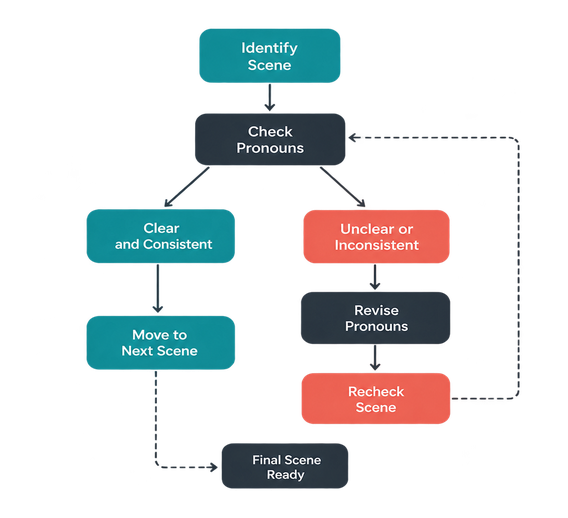
Follow this four-step sequence on a single scene:
- Mark every pronoun on the page: Highlight both familiar and coined forms across the entire exchange.
- Identify its specific referent: Draw an editorial link back to the named noun each pronoun relies upon.
- Check the selected forms against your character sheet: Verify that subject, object, possessive, and reflexive positions match your design for that individual.
- Inspect every entrance of a new plausible referent: Wherever a second person steps into the paragraph or handles an object, test whether the syntax still points cleanly to the intended actor.
To prevent drift across a long project, build an author-facing consistency note in your working manuscript materials. Do not treat this note as mandatory front matter that the reader must study before chapter one; keep it in your style guide to govern line edits. A complete consistency entry for our courier looks like this:
Selen; xe/xem/xyr; independent possessive xyrs; reflexive xemself; singular verb agreement, as in "xe is" and "xe has"; same pronouns in private speech and official records; ceremonial titles recorded separately.Recording details that may not appear in the opening scene—such as singular verb agreement or the separation between personal pronouns and ceremonial titles—ensures that later chapters remain structurally coherent when the story moves from a broken hatch to a formal hearing.
When you hand the pages to critique partners, avoid asking vague questions about whether the pronouns felt smooth. Instead, separate your beta-reader diagnostics into two targeted prompts:
- “Who performs each action?” If a reader hesitates over who moved or spoke, the fault lies in reference tracking or physical blocking. For example, if a draft reads, “Selen handed Iri xyr tether before xe jumped,” the reader cannot tell whose tether changed hands or who leaped first. You fix this through physical staging without altering Selen’s selected forms: “Selen clipped xyr tether to Iri’s harness. Iri jumped first.”
- “What does this grammatical choice change in the scene?” If the reader can track every physical actor cleanly but cannot tell why a character switched from an individual pronoun to a voyage-collective form, the fault lies in your worldbuilding setup. Clarify the concrete social or financial consequence inside the scene’s reaction beat.
Open your current manuscript right now, choose one scene, introduce the focal character by name, and revise the very next exchange so every unfamiliar form has an unmistakable referent and an active reason to be on the page.